Hug them tighter…


There were probably more than ten thousand people on Dashwashamedh Ghat in Varanasi that evening to watch the evening puja. And my two-year old daughter decided to assert her new-found independence amongst that mass of humanity. She rebelled in Sean’s arms, scrambled down and started walking away to explore the chaos around her on her own two feet and in her own terms. She looked back at us and dared us to challenge her stand – the days of molly coddling me are over, parents! Deal with it.

For the uninitiated, Dashwashamedh Ghat is the most important ghat on the bank of the holy river Ganga, in the city of Varanasi in India. Varanasi is one place where ancient India has been preserved in its essence and ambiance. The old city seems to be warped in time, continuing the ancient heritage with the rituals, the lighting and floating of the diyas, the chants, the priests, the faith. To me, Varanasi, especially the old city, still retains the aura of the India that we read about in history books. The mystics, the sadhus, the beliefs, the believers – Varanasi is the confluence of all these. And Dashwashamedh Ghat happens to be the most famous of the ghats on the banks of the river Ganges where one can see the mass of humanity proclaiming their faith – seeking and hopefully finding too.

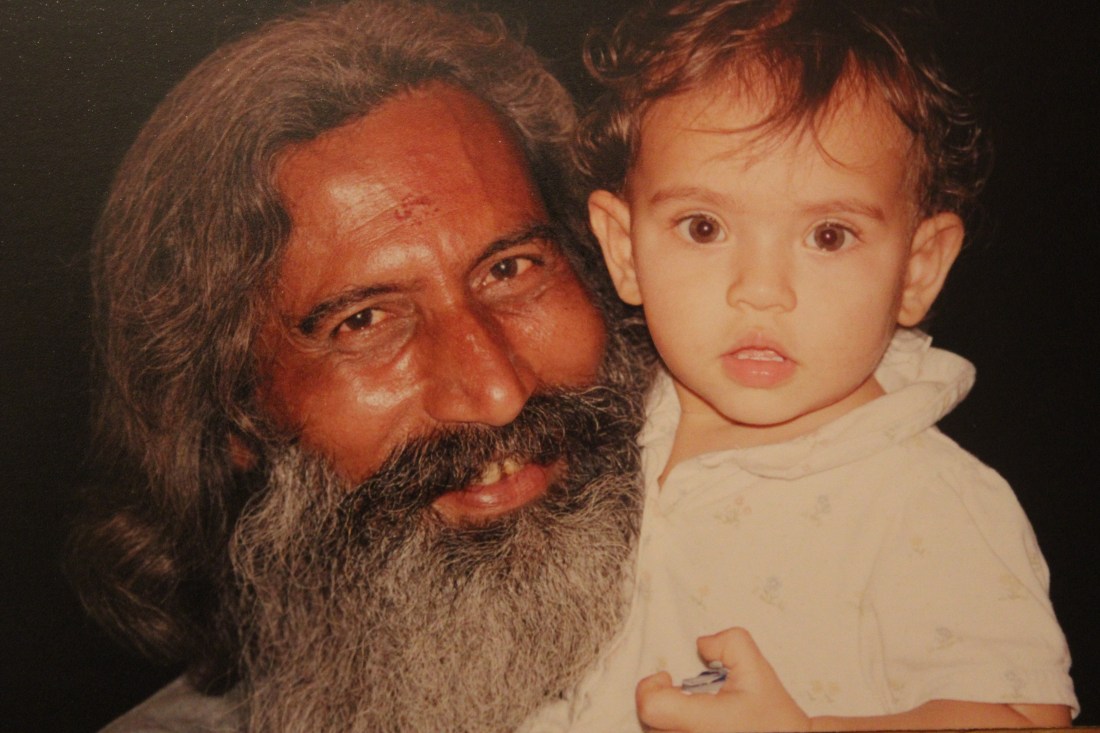
Sahana took off and immediately got lost. I shrieked, Sean sprinted towards the direction she headed, she hadn’t made too much progress since she had been picked up by a sadhu (holy man) and the two were chatting like long-lost friends.
IMG_6874

The gentleman said a lot to Sean with a beaming smile, Sean returned the beaming smile but shrugged helplessly when it came to conversation. The man kept Sahana on his lap and continued to introduce her to his fellow sadhus. They all talked to her, laughed with her, let her touch their white matted beards, tug their matted hair and touch the beads around their necks, blessed her and gave her some fruit. Sean and I tagged along behind them, not taking our eyes off our precious daughter, yet the camaraderie between the little girl and those men were so evident, we didn’t have the heart to intrude. Finally, when all the talk was done, all the laughter was shared, the man handed Sahana back to us with a final blessing to the child.

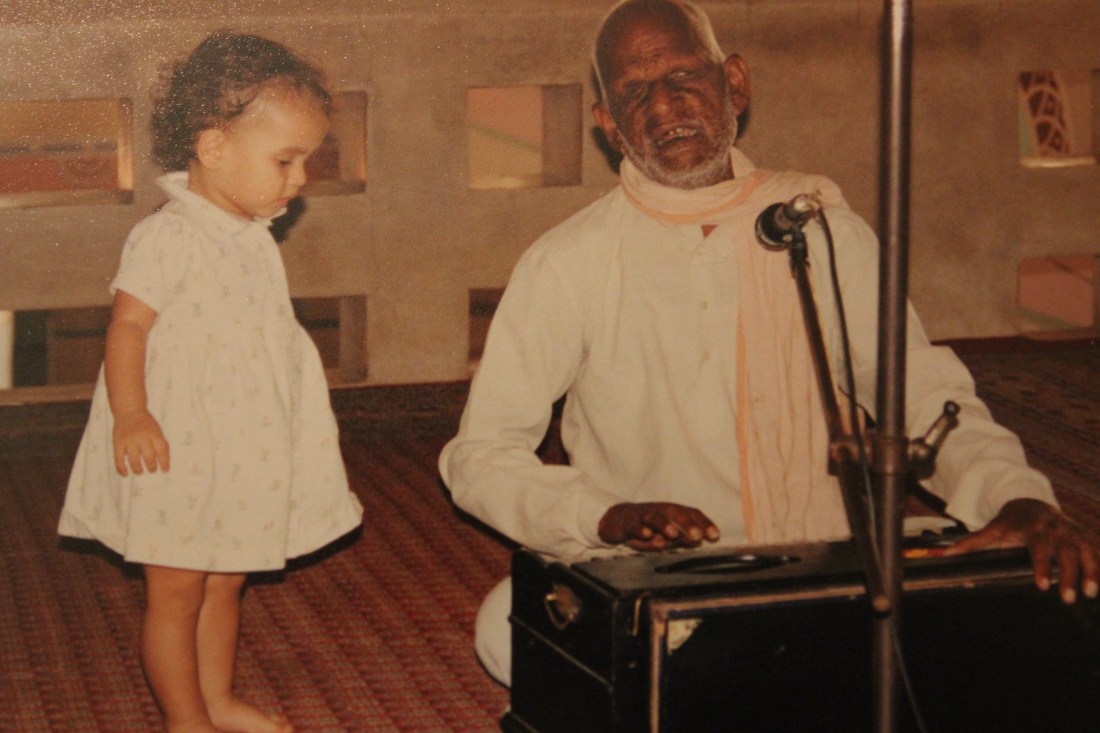
Next day we went to a temple, where Sean was allowed to go in. It was crowded, the seekers were seeking blessings from the goddess, we were mere spectators of the ritual and of the celebration of the faith. Sahana let go of my finger and walked along to stand next to a blind man who was playing a harmonium and singing devotional songs. She listened intently for a while, with the air of a connoisseur, and then decided such music deserved some dancing. She started twirling and dancing in front of the blind man. People stopped to watch, the murmur stopped, the priests paused. There was this little baby girl in a white frock and a dark-skinned, blind old man in white kurta and pajama. The world belonged to them. The moment was surreal. A crowd formed around them. A man standing next to me said in a reverent whisper, “The goddess is in that child, you see. The goddess is dancing to the music. God manifests itself in children, and you see the proof. The child is one with the goddess now!”
IMG_6875

IMG_6873

We were in Ubud, Bali, when Sahana was about seven months old. We were walking along the beautiful city with Sahana in our arms when a matronly lady came running out of a house, smiling and chattering to us in her own language she took Sahana from our arms and started walking back to her house. Sean and I were so surprised at this sweet, smiling assault that we couldn’t react for a few seconds. We, then, ran after the lady quietly and entered her house. She was showing the baby to her family members and although we didn’t understand anything that was being said, we understood the universal language of love. We stood there basking in the reflected glory of baby Sahana till the family had their fill of her gummy smiles and belly laughs and handed her back to her expectant parents so we could continue our leisurely sojourn through the city. A lot was said to us in their language and some treats were given to us for the little one.

A very dear friend wrote a letter to Sahana right after she was born. Her first letter. In the letter, our friend said to her not to believe when people say the world is not a good place at all. The world is so beautiful and she will discover it for herself one day – the beauty of it all. I truly believe that is true. I think she is already on her way to discovering how beautiful our world is. How can she not when her life has been and is constantly touched and blessed by all the love that surrounds her?

Last year we went back to Kolkata, India during the summer. I asked my children to tell me what they liked the most about Kolkata and what they liked the least. The least liked aspect of Kolkata was the smell and the honking of the cars. The most liked aspect was the love that they felt everywhere they went. Grandparents, uncles, aunts, the autodriver who advised their mother, after seeing they were drenched in a summer rain, ‘Didi, make sure you go home and have the little ones take hot showers, so they don’t catch a cold” ; the bus driver, who held their hand so they could get down safely from the rickety public bus, the local sweet shop owner who always gave a special sweetmeat to the kiddos, as a special treat for going by his sweet shop.

My children have been touched by so much love in their lives that sometimes I wonder how could they not turn out well. They have felt the love in so many places, in so many ways, by so many people, in so many countries. How can they remain immune to the good will and love that surround them?

Hug your children a little tighter friends, so they feel the warmth. And they remember the warmth. So they can carry the warmth with them when they grow up and share it with those who are unloved and cast aside. Heaven knows, we need a lot of that love and warmth to obliterate the suffering and pain caused by cold hearts. The world needs more loving, hope the loved ones can provide.

A rare crowning glory moment.


I am probably my harshest critic (except when it comes to cleaning my house, only then do I give myself a well deserved break 🙂 ). I over analyze my answers to the children, I try to reason with them, I try not to hover (which, unfortunately, is my natural tendency), I give them room to make mistakes and  encourage them to learn from the same. I set myself to pretty high standards, which, most of the times I can’t achieve, then I feel guilty. I know, I know, it is a vicious cycle. Life is a work in progress, I am working on it. I say to self, ‘Self’, I say, ‘Take a deep breath and calm down! If you are late in dropping off your child at a football practice by ten minutes because you had to pick up your daughter from swim practice, it is OK! The world won’t really stop spinning!’

As I parked the car in the football field to pick up Ryan, Sahana asked me a question as she unbuckled her seat belt:

‘Mom, how do you do it?’

‘Do what?’ I asked.

‘Tell us ‘no’ and we listen. No questions asked. How do you make us listen?’

‘No questions asked’ is stretching the facts a bit. Questions are asked and more than I care to answer them. I also explain my reason for saying ‘no’ to certain requests to the best of my ability. When arguments, talk backs start, I put my foot down and say ‘Because I said so!’ Parenting books will condemn me for that. So be it.

‘You guys ask questions before you accept ‘no’s!’

‘Yeah, sometimes! But we know that when you say ‘no’ you mean it and we accept it. How did you make this happen? I want to learn. I want to be a parent just like you!’

I will be honest, that made my heart sing. Standing ovation in a full auditorium can not compare to what I felt in my heart at that moment. I just got my report card and guess what? Straight A’s!

“But when I say no to something you really want to do, you get angry, don’t you?” I probed.

“Yes, but that is just the irrational me then. Now it is the rational me asking you how you do it? Tell me, I will do the same to my children!”

What I said to her is not the main objective of this blog. Some time ago, I wrote a blog about how Ryan asked me if having them was the most difficult decision in my life. I was crushed thinking I made them feel that way by complaining and whining about the stresses in life. Last night, I felt validated. My love was shining through. They saw it! My teenage daughter wanted to emulate my style of parenting.

I know my joy is short-lived. We will have conflicts aplenty and often. But I will look at them as her ‘irrational’ moments. I will cherish these fleeting rational moments for now and garner strength and joy from them to keep my composure when the teenage turmoil flares up and I become the meanest human on earth again!

Respect


Recently I watched a Hindi movie English Vinglish, by myself because my husband flat-out refused to sit in a movie theater for almost three hours. The much talked about English Vinglish, according to the rumor mill, was made by the director to apologize to her mother.

The story line doesn’t include the usual song and dance sequences that are the trademark of most Hindi films. The movie tells the story of a woman – a mother, wife and a daughter-in-law, who constantly puts the needs of her family ahead of her. Her morning cup of coffee cools as she gets up to make breakfast for her mother-in-law, her husband and cater to the various needs of her children. She is the symbol of the quintessential Indian woman, or at least how the society expects them to be- traditional, domesticated, loving…and a martyr. If there is frustration in her, it doesn’t show, she takes care of everyone with elan and also runs a small business of making and selling an Indian dessert – a laddoo.

She wears the traditional dress of India – a saree, and doesn’t speak English, the language of choice of the middle and the upper level of the social strata. Her teenage daughter is ashamed of her non-English speaking, traditional attire wearing mother and screams her annoyance at this social ‘lack’. She wants to keep her mother hidden from her friends and teachers in school. The husband and the daughter ridicule her English pronunciation as the camera zooms in on the woman’s uncomfortable, embarrassed and sad smile.

A lot happens but I will let you go to the theaters to watch the rest. The plot written above is just a teaser which I got paid to write to lure audience (kidding!)

This dynamic between the mother and the daughter paused me to think back and reflect on my relationship with my mother when I was going through the turbulent years which we call teenage. As a child, I remember a sense of wonder filled awe towards this beautiful, strong, opinionated woman, who was my mother. I was her faithful follower. I emulated her laughter, thought the way she did, observed her kindness towards others and tried to please her always. She drilled in me I had to be someone in life, she told me I was bright and smart and I could do absolutely anything I wanted. I worked hard and got good grades to see the brilliant smile that shone on her face as she looked through my report card. She didn’t have a strong command of the English language but she enrolled me in an expensive, English medium school, the fees of which, we hardly could afford. She foresaw the need for English in my future, where a solid knowledge of the language will give me a boost in life. She struggled financially to pay the fees, but both my parents grit their teeth and paved my way for a better future.

As I thought hard about my feelings, as a teenager, towards my mother, I remembered many emotions I felt towards her over the years. Embarrassment was not one of them. Why wasn’t I ashamed of the fact that she didn’t speak the language or didn’t wear western clothes. First, it was a different age. Speaking in English was definitely important but the disregard for vernaculars didn’t reach to the degree that I see today when I go back. Most of the women of her era wore traditional clothes so I didn’t have anyone to compare her to and be embarrassed about her. But more importantly, I believe she had this aura of self-confidence around her which earned my respect. I never felt embarrassed about her for her lack of another language because she introduced me to a treasure at a very early age – literature in my vernacular. She told me stories, read me books in Bengali when I had no letter recognition. I was taught to read and write in English before I learnt the Bengali alphabets. She cleverly introduced in me this lust for more and more Bengali literature by reading to me works of Sukumar Roy, Rabindranath Tagore, Abanindranath Tagore and numerous other magic weavers. And did they weave their magic on me! I followed my mother around with an open book while she gently reminded me I could read these all by myself if I learnt to read the language. Learn, I did and how! I was like a sponge, I soaked up the language with a determined focus – to read Abol tabol, Buro Angla, Raj Kahini, Shishu, Aryanyak, Pather Panchali, Adarsha Hindu hotel, Bindu r chele, Chander pahar….

She taught me how to think and scratch the surface. Before I read Dr. Seuss’ ‘Horton hears a who’, she taught me a person’s a person no matter how small. Her comment about lack of English was something I tell non-English speakers in this country. She said, ‘I can still speak enough English to get by, most English speakers can’t speak my language. Are they ashamed of it? No? Then why should I be?’ When I grew up and married an English speaker, who doesn’t understand a word of Bengali, he whole-heartedly agreed with her. When a lot of people including my extended family exclaimed how lucky I was to find a husband like Sean, my mother was the only one who smiled and said to Sean, ‘You know you are the lucky one, right?’ Sean said he knew.

I loved spending time with my non-English speaking, traditional saree clad mother even in my late teenage. I remember coming back home early to go see a movie with her and answering friends’ questions ‘Who goes to movies with their mothers?’ with ‘I do!’ When I started to think independently and started spreading my fledgling wings, roles reversed a bit. She started listening to my points of views and nodding in agreement sometimes. She has this amazing ability to learn from anybody so today she can keep up with various generations and speak and understand their language. I started bringing home new music, new ideas, different thoughts. We disagreed often and debated on issues but she realized I was coming to my own. I was her long time companion, and I was slowly letting go and she felt the pain

I am a mother of a teenager now. I often talk to her about the heritage of my land that I am, hopefully, passing on to her – respecting an individual for what they have and not insulting them for what they do not. I often emulate my mother while parenting my children. Sometimes I find myself saying the exact same thing my mother used to say to me. I break down laughing, ‘This is what your didiya used to tell me when I was your age!’ I tell them. This continuity sometimes diffuses a stressful situation when the children smile with me, picturing their mother as a little girl and at the receiving end.

As I narrated how the teenager demeaned her mother, my teenager asked me gravely, ‘Mom, do I ever make you feel that way?’

I asked her back, ‘What do you think will happen if you made me feel that way? Do you think I will take that kind of behavior from you?’

‘I will be grounded till kingdom come? But that is not an issue because I don’t feel embarrassed about you, anyway!’ she responded.

My mother was and still is my biggest fan. She was the champion of my cause, my number one supporter, the sail beneath my wings. She loved me unconditionally, stayed up all night to tend to my sicknesses, nourished my intellectual needs She did all that and she demanded respect in return. I was not allowed to get away by being disrespectful. She was not the conventional mother figure to stay at the background and be a martyr. She is a strong woman who made her presence felt in my life and I am ever so grateful for that.

A life time of love and respect (oh well, alright frustrations too at times:) ) can’t be captured in a blog unless I write reams and reams about it. Unfortunately, some emotions can not be expressed no matter how much one writes about them, those are special feelings meant to be just felt in one’s heart. So I will end my tribute to her here. It is her birthday today and I am physically thousands and thousands of miles away. But in my heart

‘I’m already there
Take a look around
I’m the sunshine in your hair
I’m the shadow on the ground.

I’m the whisper in the wind
I’m your imaginary friend
And I know, I’m in your prayers
Oh I’m already there’

(Lonestar)

The blog is my feeble attempt to show my love and respect that I have for you as my mother and as a strong, beautiful woman of the world. Thank you for helping me to be who I am and sorry for causing you sadness and frustration at some points in our life together. I now fully comprehend when you said to me, ‘Wait till you are a mother yourself!’ I know now.

Shubho Jonmodin, Ma! Happy birthday!

You are weird, I like you!


I wouldn’t dream of generalizing, of course, but can I please say the above lines to all the middle schoolers out there? ‘You are weird, I like you!’

I found this sentence on my thirteen year old daughter’s i Touch welcome page. The conventional me frowned at this and condescendingly shook my head, ‘Kids!’ I patronized.

Weird, in our days, was used mainly as an insult. A brief history of the word ‘weird’, according to Oxford Dictionary is this:

Origin:

Old English wyrd ‘destiny’, of Germanic origin. The adjective (late Middle English) originally meant ‘having the power to control destiny’, and was used especially in the Weird Sisters, originally referring to the Fates, later the witches in Shakespeare’s Macbeth; the latter use gave rise to the sense ‘unearthly’.

The ever evolving language had changed the meaning to the ones we know now – bizarre, odd, something preternatural or supernatural. The teenagers seem to have embraced the original meaning of the word, and are bowing to this power to control fate. They are slowly emerging from the cocoon of their innocent childhood and looking at the huge world around them with a fresh pair of eyes and newly formed sense of self. They are trying to make sense of the chaotic world in their own terms. According to them, the possibilities are endless, they are in charge of their destiny. They are slowly letting go of their parents’ fingers as they test the waters, push the envelope. They believe they have the power to control their fate, they are weird and they like it. At this junction of my life, when I am mostly tired and wilting, I look up to them to draw energy. They are my sunshine, so bright and radiant. I celebrate this age along with the poet Sukanto Bhattacharya

এ বয়স জেনো ভীরু, কাপুরুষ নয়
পথ চলতে এ বয়স যায় না থেমে,
এ বয়সে তাই নেই কোনো সংশয়–
এ দেশের বুকে আঠারো আসুক নেমে।।

E boyesh jeno bhiru, kapurush noy
Poth cholte e boyesh jaye na theme,
E boyeshe tai nei kono shongshoy-
E desher buke atharo ashuk neme.

Unfortunately, I am no translator but the gist of the lines is this:

This age is not one of cowardice,
This age is unstoppable in its pursuit of its dream
This age has no doubt or fear
Let this age bless our country.

Often times, when the children were young, they would pass a judgment on a peer ‘Mom, so and so is so weird’ only to be reprimanded by me, ‘nobody is weird, people can be different and that makes the world so much more exciting.’ The word ‘weird’ was not entertained in our household, precisely because the mother and the father grew up disliking the meaning of the word. It stood against our value of celebrating our differences. It reeked of segregation, disrespect.

But language is called fluid for a reason. My daughter likes someone who is weird. What does the word mean to her? Weird is someone who is non conformist, who thinks outside the box, who pushes the boundaries without hurting others. Weird is the new word for visionary. At this age, teenagers form a band – the band of the misunderstood, the victims of their parent’s persecution and unfair curfews. They break free from what the parents think is normal. Normal is so relative, I am reminded often. Being weird is a good thing, I learn and accept.

I like this weird generation a lot. Yes, despite the eyerolls, the grunts, the exasperated sighs, the trance like state when they are busy communicating virtually, I simply love them. I love the excess of emotions, both tears and laughter, (and yes, there are frustrations sometimes). I love the positivism, the self-reliance, the emerging independence. I love their view of their world. I love their new-found ability to peel off the surface and look beneath for deeper meaning of life, of world. They are vulnerable still, they are still malleable, to some extent, but not for long. They are a work in progress still, but inching closer towards completion.

The poet who I turn to again and again to find a way to express my emotions, Rabindranath Tagore, celebrates the youth with these words; and he too uses the word adbhut, a Bangla word that can be loosely translated to…..wierd!

Amra nutan jouben er i dut
Amra chonchol, amra adbhut.

We are the messenger of New age
We are restless, we are strange;
We are the messenger of Youth.

Strange denoting different. Different is good, different should be revered, celebrated. Isn’t that what we teach our children as well?

We walked a walk and talked the talk – a bit early maybe.


Sage (my dog), Ryan (my son) and I went for a walk today and did some serious exchanging of ideas. Sage didn’t share much. He was somewhat preoccupied with the various dog pee smells in each and every tree trunk or light post that we encountered. Ryan and I did most of the talking. Ryan may well be seven years old, he is very wise for his age.

The conversation started with how summer was going;  is Ryan excited about second grade; is mom excited about her new job and such like. Then we moved on to the question of how the first tree was created and whether the trees that we see around us are the descendants of that first tree. Then next topic we discussed was how Sage’s shadow resembled one particular type of wolf, and my young scientist gravely declared that Sage has descended from that particular wolf who has left his shadow with Sage as an inheritance.

We got into serious grounds next – drinking alcohol. Sean and I don’t drink alcohol. I tried it as a youngster, never liked the taste, never felt the need for it in my life. Sean made a conscious choice to stay away from alcohol because he too didn’t feel the need to introduce that poison in his body. In fact, I heard this story on my wedding day from his friends:

“Your husband is a piece of work. He went to a bar in Costa Rica with friends and ordered a glass of milk!!!”

Ryan and Sahana have decided not to drink alcohol as well when they are adults.

On our walk, Ryan asked me if making the choice (of not drinking) was difficult and more importantly is it going to be hard for him when he grows up. Teaching moments, or rather talking moments like these don’t come up often in our hectic schedule. So I put it to good use.

For me, the choice was relatively easy. In the mid eighties India when I was a teenager, drinking was still considered a taboo among the middle class, especially for girls. Most of my girl friends abstained from drinking and the boy friends didn’t expect us to drink anyway, so there was not much peer pressure, or the need to conform. Sean had more of a difficult time growing up in America where drinking alcohol had more acceptance as a social norm. But after the initial ‘Come on man, just one drink’ people respected his choice and left him alone. They also appreciated his voluntary service as their designated driver after parties.

Ryan and Sahana, I believe will have more of a difficult time standing their ground, if they choose to stay away from alcohol, than we had. I say this because in first grade play ground  discussions, little boys and girls have already questioned Ryan about his choice, “You are so funny! Why won’t you ever drink? I have sipped from my parents’ drink, I like it!” I told him he is going to hear more of it as he becomes a teenager. Teenage drinking is a huge problem world wide. And really, what is the harm in one drink? One glass of red wine is even beneficial for health, I often hear. The harm is, one drink often becomes two and then becomes three. His strength of character will be sorely tested when and if he refuses drinks in people will back off and respect his choice if he stands his ground.

I am a firm believer in ‘live and let live’. I have made my choice in my life. I respect other ADULTS’ choice of enjoying their alcoholic beverage as long as they don’t harm others under its influence and don’t get behind the wheels after downing a few. We have spent way too many moments of silence in different sporting activities, in memories of teenagers who lost their lives to drunk driving. I am not going to go into statistics, it is out there right in front of our eyes.

Life is about making choices. My children will make a choice on this when they are at a legal drinking age (I hope). My job, as a parent, is to make sure they are aware of all the ill effects that alcohol has on human body and let them make an informed decision. All I can hope is my children stay away from it.  And if they don’t, then I hope they make good judgments of how much and when to stop. Most importantly, I hope they designate a driver!

Do our children suffer from Nature Deficit Disorder?


‘Last Child in the Woods is the first book to bring together a new and growing body of research indicating that direct exposure to nature is essential for healthy childhood development and for the physical and emotional health of children and adults. More than just raising an alarm, Louv offers practical solutions and simple ways to heal the broken bond—and many are right in our own backyard.’

Richard Louv talks about Nature Deficit disorder in his book “Last Child in the Woods. He writes about how the wired generation is slowly yet steadily severing the connection with nature as they remain glued to their smart phones and tv screens, resulting in rising obesity, attention deficiency disorder and depression.

Children stay indoors, hooked on to their smart phones, busy staying connected with the world, sharing their one liner responses and repartee. They are oblivious to the inconspicuous little violet flowers blooming amidst the green grass, or the bright yellow dandelion growing in their own backyard, or the red breasted cardinal trying to woo his plain brown mate, and the butterfly fluttering around the rhododendron bush. They don’t see these anymore as they are completely submerged in their virtual world. But the virtual world is just that, virtual! There is nothing new that I can say about the lessons of nature! It has all been said before! The great outdoors broaden our horizon, rejuvenates our souls, humbles us in its great expanse, reminds us we are mere specks in the grand scheme of things. Nature inspires us to create, we aspire to touch its beauty in canvas, in written words, through lenses. The changing season teaches us transience of time, the fleeting moments we have in this world and we should, indeed, seize the day. We really do not need to hike the Pacific Crest trail to be one with nature, we simply need to look up and look around.

I grew up in the congested city of Kolkata, far away from nature. Granted Kolkata was greener than what it is now, but it was still bereft of much natural beauty. Sure there were more trees, maybe some more green fields for children to play in; yes, a few more ponds that had not been devoured by man’s growing needs. Kolkata wasn’t sprawling out to the country side so when we took the train outside the perimeters of the city, we could still see the soothing green. So how did our generation, that grew up in big metropolises and far away from natural splendor escape some of the ill effects of Nature deficit disorder? I believe literature and human connection saved our generation – the generation of city dwellers. We still developed the sensitivity to appreciate the great outdoors because we read books and let our imaginations soar. We saw the ‘host of golden daffodils’ along with William Wordsworth and we too, with the poet, rejoiced at the memory, when ‘in vacant or in pensive mood.’ We went on journeys with poets and authors and learnt to look at nature through their eyes and through their words. Their words seeped into our hearts and made permanent tattoos of woods covered with snow and a lonely horseman pondering the miles to go before he sleeps, or the bright star that ‘not in lone splendor hung aloft the night’ (Keats)! We accompanied Apu and Durga of Pather Panchali (Bibhutibhushan Bandopadhyay) as they lost themselves in the magnificence of nature and discovered the joys of the unknown along with them. We, too, witnessed ‘Starry night’ along with Van Gogh. We named the nameless tree growing next to our window, “Amaltash” because we loved the name in Buddhadeb Guha’s books and imagined ourselves under its shade.

We heard stories of kings and princes and again our imaginations took flight. We fought along with them to bring peace, save the princess and slay the demons. But our children have routine, they have structure, they have practices. They have soccer and swimming, they have piano lessons and dance classes. Their evenings are structured to the very last minute till bedtime. So this summer, I decided to break free. My seven year old didn’t do any summer camps, my thirteen year old was left free to read and listen to music to her heart’s content.

They had time to lay on the grass and stare up at the sky.

And imbibe this serenity in their young minds!

Or soak in every bit of happiness that such a scene can evoke, right in their backyard.

We chased butterflies.

And saw one settle on a flower.

We caused ripples.

And we noticed the wild flowers and the bee.

Our children belong to this age of technology. They will be outcasts if they are not wired but then again, they will lose out so much more if they don’t cast off their wires often and open the door to the great outdoors. At the end of the summer, the children were ready to go back to school. They actually voiced their need for structure and routine in their lives. The seven year old, however,  knew a lot more about spider webs, butterflies and skimming rocks; the thirteen year old surprised me with quite a few songs that she wrote over the summer. And also this poem….

Beauty is nature
The pounding waves,
Scarring immortal rock
Leaves but a grain of sand.

Beauty is nature
Lulling me to sleep.
The darkness surrounding,
The whispering wind.

Beauty is nature
A leafy green tree
Wildlife vastly stretches
As man, a speck of dust, screams his significance.

Happiness isn’t complicated.


I will be labeled as a happy person by most. I greet people with a happy smile. I never forget to raise my hand to neighbors as they are driving by. The fact that I generally carry dog poop in a plastic bag in that hand and raise the dog poop in greeting is beside the point. You see, I generally see my neighbors when I walk my dog. I always wave frantically to drivers who let me go by with a casual flick of their hand. I am overwhelmed by the show of generosity in people in general.

And then there are occasional days when I am run down, cranky, hungry and tired. Then the gloom descends. Then I am a Grinch, I can literally feel my heart shrink three sizes. I don’t want to smile at the nice lady handing my provolone cheese at the super market. I smile anyway because I, too, work in customer service. Anyway, this evening was such a time when I felt I bore the weight of the world on my shoulders. I went to work, dashed back to cart my two children back and forth between swim team, football practice, confirmation meeting. In between dropping off and picking them up, I stopped at the grocery store to pick up provisions for the week. Grocery shopping, being one of my least favorite activities, did nothing to elevate my mood. The tiredness and empty stomach aggravated my grumpiness to no end.

While I tried to zip by the aisles, throwing things in my cart, a young mother tried her best to block me at every step of the way. She was having way too much fun in the grocery store with her toddler. The toddler wasn’t walking yet, she was scooting around on the dirty floor of the super market. The germophobic me shuddered at the scene and the veteran mom in me wagged a finger at the new mom. Get that baby off that floor immediately, woman! I wanted to scream. As I stood, somewhat impatiently at the deli to get my three-quarter pound of provolone, I heard a squeal. I turned around to a scene that brought the biggest smile to my face. The baby was taking her first steps – at the supermarket. And the mother was squealing her encouragement and filming the momentous event at the same time. The other grumpy shoppers like myself, stopped in our tracks to savor the moment. The woman in the deli left my cheese on the weighing scale while we all joined in aaahing and oooohing at the feat of the proud toddler. She waddled for a few moments and then went down on her bottom with a happy, two teethed grin. We all clapped! “Awww, honey, do it again!” “What a big girl!” “You are walking!!” Comments came from all sides. The mother looked at us, beaming, ‘Her first steps! She took her first steps!’

A special moment in the child’s life, and in the mother’s life, as well. We, the grumpy, Grinchy shoppers at that supermarket will always be a part of their joy and special memory. The thought made me happy. The line was long at the check out counter. I didn’t complain. I went to my car, unloaded my groceries and asked a woman who parked next to me if she needed my cart. She took it with a big smile and a grateful ‘thank you!’

Happiness isn’t really complicated, if you think about it. There are these little moments strewn around us like treasures. The moment when the big black and yellow school bus pulls up to my drive way and I see through the window a beautiful teenage girl sedately walking towards home, lost in her own thoughts; or a rambunctious seven-year old running like Usain Bolt because he is free from school. The moment when I see the back lights of Sean’s car backing into the driveway after a day’s work. The moment I feel the wet nose of Sage touch my feet in unconditional love. The lonely dove sitting on the electric wire against the back drop of a spectacularly clear, blue sky. The moment when I look out of kitchen window into my back yard to see the most fascinating sunset. I can string these moments together and wear them as a garland when my heart starts to shrink three sizes down. I simply need to look around and be mindful of the innumerable moments that I own, yet often, don’t realize.

Spare the child, I really don’t care about the rod!


Corporal punishment and its effectiveness have been part of discussion for some time now, since the new fangled parenting books hit the markets. I read parenting books with a grain of salt because there can be no one formula that we can apply for every child. Each child is different, what works for one may not work for the other. I read some anyway because I can always find a new idea that I think may benefit my children and help me be a better parent.

There are some absolute truths in good parenting, though, the first being consistency. Setting out rules and expectations and following them and holding the children up to those expectations. Of course, the expectations should not be unreasonable so the child is set up for failure. While being consistent on the core values, certain flexibility often makes the journey more fun for both the parent and the child.

I do believe, however, corporal punishment is not effective means of parenting. It instills fear and in some cases, it breeds violence. Why do we punish children in the first place? The goal is for children to realize, from an early age that each of their actions has a consequence. Good choices yield positive results and bad choices bring on unpleasant reactions from the grown ups. The end result of spanking or time outs is the same – to make the child realize that they made a bad choice. The parents take the responsibility of ingraining the socially acceptable behaviors in a child when they start toddling around. Most of the parents teach their children to keep their hands to themselves since they cross the threshold of preschool. Children are naturally physical, keeping their hands to themselves is an acquired social skill that are taught by parents and teachers. If the parent uses their hands to inflict physical pain, what message are they conveying? I have seen a father swat at his child to stop him from hitting a peer. What did the child really learn? It’s ok for dad to hit, but it is not ok for me to do the same? Prime example of double standard right there. Children may display a desired behavior for the fear of getting physically hurt, but is that desired behavior ingrained in them? Will they behave well because that is the right thing to do?

Many equate lack of corporal punishment to lackadaisical parenting. Kids get spoilt if they are not dealt with a firm hand – literally. Spare the rod, spoil the child may just be the most quoted line from the bible. I have heard we are bringing up a generation of spoilt adults because we believe in the new fangled parenting of not spanking. That, I think, is far from the truth. If a child is occasionally spanked for some misgiving, yet the parents give in to all his demands at other times, he will eventually grow up to be selfish, spoilt and yes, to some extent, violent. When it is their turn to be parents, chances are, they will continue corporal punishment quoting ‘spare the rod, spoil the child.’ I do think a parent can be strict and effective without raising his/her voice as long as they stick to their guns. Some feel a spank here and there is far more effective than constant nagging. I agree nagging is useless. the children tune you out, it falls in deaf ears but kids get used to spanking too. They know it hurts for the moment but the moment passes. So it is not really a good alternative.

Most spank their children to teach a lesson, and not to really hurt them. Ideally, if the anger element can be kept out of spanking and it made clear to the child that this kind of punishment is being meted out to him for a particular bad behavior, it MAY yield result. But there are parents who need lessons in anger management. Corporal punishment is a slippery slope then, it can lead to a trip (or many) to emergency rooms. It has happened before and happens often, unfortunately. Does spanking in childhood traumatize the child for life? Most cases, it doesn’t. They grow up and live to tell the tale. I was spanked pretty regularly, now I laugh with my mother and give her a hard time about it. She says she made a mistake when she hit me. She has realized later in life she shouldn’t have inflicted pain and I should never, ever hit her grandchildren. Yes, we see some double standards here 🙂 !

Having said all that, I know it is easier said than done. I have smacked my children a few times in their lives. I have come close to spanking them many more times than I care to remember. I have seriously counted till ten to get my anger under control. I have yelled at them, nagged them, and done everything that parents do when they lose control. I am not holier than thou, by any means. But then hated myself later remembering their scared eyes. I lost control. Moreover, I lost control on little people who are completely dependant on me. I am their protector, I would never want them to ever feel I will inflict them physical pain. I am an assertive parent and I want them to recognize my authority over them for making serious decisions but not by beating them to submission. I apologized to them and promised I will never raise my hands again. I have kept my promise.

Are my kids going to be better humans than another who is spanked in childhood? Heck no! I hope they will be happy, successful individuals and so will be the child who was occasionally spanked as a form of punishment. The choice of corporal punishment is more about me as a parent. It is about what kind of parent I want to be. The idea of inflicting physical pain to teach a point does not appeal to me. That doesn’t mean they won’t hate me till they are thirty. And the same fate awaits my fellow parent who reaches for the rod instead of taking away a favorite toy for thee days for a particularly serious misgiving. I just won’t have to say later, ‘I shouldn’t have hit you when you were a child. That was a mistake. But don’t you EVER lay on a hand on my grandchildren!’ 🙂 ! At the end of the day, not choosing corporal punishment is really about who I am and what kind of parent I want to be.

I happen to be a red light!


Seven year old Ryan was upset with me. Very upset. He held an Angry bird hat in his hand at a store, pleading his hard hearted mother to buy it for him. Mother was firm, the house could not handle one more hat. The cup (of hats) runneth over………in our house. Moreover the branded products are pricey. ‘Take the money out of my bank account!’ He offered.  ‘No way, Jose! As your mother, it is my moral duty to teach you financial responsibility. I can’t let you throw your money away over something like this. The answer, still is no! Please don’t argue anymore!’ Mother was losing it, fast!

While waiting in front of the fitting rooms where his sister tried out school clothes, Ryan came up with one of his thoughts ‘Mom, I have thought of something!’

‘Wonderful! Would you like to share your thoughts?’

‘In every family, the mothers are harsh, dads are fun and kids are in training. I think mothers are red lights, dads are green lights and kids are yellow lights. The kids could go in any direction depending on who’s training them. The girl kids are trained by the moms so they grow up to be red lights while the boy kids are trained by dads, and they grow up to be green lights.’

‘What???’

‘Yes, see how Sahana is a cranky teenager, she is a yellow light almost turning red under your training. I will turn green because I am being trained by dad to be the fun one!’

Ouch!

After shopping for clothes, I took the children out for lunch and allowed them the ‘unattainable’! A soda to go with their meal. Not coke or pepsi, mind you, just an orange soda! My soda deprived children couldn’t believe their good luck. Ryan, whose way to the heart is through his stomach, was almost giddy with joy. It was then that I asked him the important question. ‘Do you still think mommy is the red light in the family?’ I know, I know…I went deep sea fishing.

The boy didn’t miss a beat, ‘Well, soda is bad for us, daddy doesn’t approve of it, but you are allowing us to do the wrong thing anyway. So I guess you are still the red light!’ I was so tempted to stomp my feet and sulk at that!!! I did it mentally just to get it of the system!

After lunch, we headed to the car, the red light in the family turned the ignition on to head back home. It was a no win day for the mom lady, one measly hat, or rather refusal to buy one measly hat had ruined me….for the day. That is when my aloof teenage daughter decided to shine a ray of sunlight on my dismal day, ‘Mom, just so you know, I don’t think you are a red light at all. You are a very green light for me!’ I gave her a big, wide grin and a grateful thank you. My pride was salvaged, somewhat. I looked at my son through the rear view mirror, since I was expecting a full blown debate over my red light/green light traits of character. But he had tuned us out already. He was sipping his orange drink cautiously with such obvious joy that I was about to turn green for him. But I have a feeling he wouldn’t have acknowledged my greenness unless I drove back to the store and bought him the hat. The regret for not getting his 59th angry bird hat was running deep.

‘What is the most difficult decision that you made, mom?


My son asked me a question this morning that shook me out of my complacency that I was doing a semi decent job of parenting. This morning, between ‘Ryan, hurry up and eat’ and ‘you will miss the bus today’ he asked me, ‘ What is the most difficult decision you ever made in your life, Mom? Was it having us?’ That question stopped me in my tracks. It may not have all the implications that I am projecting on it, but it shook me to the core and made me see myself through my children’s eyes.

I am their anchor, their stability and the constant right now. And I know they love me. But they also see me stressed, angry, harried, tired, not in my best state. They have heard me groan when I see a school holiday on the calendar. They have heard me complain that the kids were driving me up the wall. They have experienced me yelling at them, nagging them to change their behavior, clean their rooms, pick up after them.

It is not unusual, therefore, for Ryan to infer that maybe having them was the most difficult decision that I ever made. That was my performance evaluation right there and I was graded poorly. It was a shock because parenting is my primary job at the moment and this is the impression I was creating.

He couldn’t be farther from the truth. Sean and I decided to see the world and travel together before starting a family. But when we decided to raise a family we were absolutely ready. Of course, when Sahana came along, we didn’t have any idea how or what we should do with her. See, she didn’t come with a manual! But we figured it out eventually. By the time Ryan made his appearance, we were pros. Having them was truly the easiest, the most natural decision we ever made. I had just mentioned to a friend, not too long ago, that I have found the calling in my life, being a mother! I enjoy it the most! Then….this!

After searching around for a few minutes for the perfect response to reassure my boy that they were the best things that happened to me, I apologized. I apologized to him for making him feel that way. I said everybody needs to work on their shortcomings, my shortcoming was my impatience. I try hard to be patient with them and I will continue to try harder. That opened up a floodgate of meaningful conversation. Sahana admitted she pushes my buttons sometimes and aggravates Ryan knowing it will end up in a fight. Ryan said he will work on focussing more on his school work. Distraction is his shortcoming, and that is a new word he learnt. Then our seven year old theologist went on to share his idea on the life we lead. He said life is a walk. Mom and dad have started walking early, Sahana started walking a little later, Ryan, even later than Sahana. Everybody starts their walk when they are born. The unborn babies are still at the starting line. Mom and dad will probably reach the finish line first, before them. With that thought, he asked me to please turn on the radio to his favorite station. The house filled up with music, the conversation ended. My mind filled up with the depth of his thoughts and the feeling of being extremely lucky and blessed to be nurturing two precious beings and seeing them bloom.

But his question did disturb me. I don’t want to behave in a way where my children feel having them was the most difficult decision. A lesson learnt, time to take stock and focus on that personal growth, mama!