Khushi


image

She didn’t have a daak nam (pet name or nick name) when we first saw her. She was simply a bundle of dimpled chin, kicking thighs, little hands and a cherubic face. As we entered our house in Kolkata, after a long 25 hour travel, we saw her intently focussed on the ceiling fan overhead, taxing her two month old brain to understand what makes the funny thing work. We walked towards her, she tried to focus her eyes on the faces of these strangers and uttered some adorable kitten sounds with a toothless smile. Sean asked me what was Bangla for happy.

‘Khushi.’ I said.

‘She should be named Khushi then because that is what she is. Khushi.’

Khushi is the new-born baby of our domestic help, Breshpati. As she lay there, kicking her impossibly little yet impeccably shaped tiny feet, Khushi didn’t know she was unwittingly the key player in a tragic drama that her birth has begun. Her birth in the ‘wrong’ gender, to be precise. Although she was born at the end of May in 2013 in a semi developed country called India, she was still unwanted because she didn’t have a penis. She was healthy and impossibly cute but she was still a girl. Her father’s family didn’t want her. After her birth in a hospital where the sanitary conditions left much to be desired and her mother had to stay up all night to keep little cockroaches off her new-born baby, Khushi’s father did not come to see her. He finally came after several days, and after innumerable phone calls. We met Khushi when she was almost 3 months. Till date, her paternal grandparents hadn’t come to see their grandchild. Breshpati was at our house, cooking for us. She meant to take her baby back to her in-law’s house after we left. She was nervous. She was nervous about the reception she and her daughter were going to get in a home, which was supposed to be her ‘forever home.’

I don’t know what can be more entertaining than babies – of any species. I can spend hours just staring at the face of a baby and Khushi provided me my baby fix. As I sat next to her, watching her dark liquid eyes, rosebud mouth, little tongue and every expression, I thought back upon the time I had given birth to Sahana. I felt on the top of the world. Was I any less than a queen, triumphant, with a living miracle in my arms? Phone calls, visits, cards, gifts, good wishes and love flooded our lives. While Sahana slept, her nursery filled up with toys which she didn’t need, and perhaps never played with. She didn’t want for love, attention or anything material. And here was another baby, lying by herself with just one rattle for toy, and the ceiling fan for her mobil. Her mother was busy cooking for another family, instead of spending every waking minute with her, like I did, to drink in the last drop of her infancy. She simply doesn’t have the luxury. And Khushi was still khushi. She learnt to entertain herself, she looked around, smiled at the light that came in through the French windows and touched her pretty face. She clung on to a piece of her bedding and tried to bring it to her mouth, she got a handful of her own hair and gave it a hard pull. Her face registered surprise but she didn’t cry out. As I stroked her soft skin, I got uncharacteristically angry. Angry at our society, the ignorance, the pretentiousness that India is shining. Angry and ashamed that girl children were still a liability, still a burden. WHY? HOW LONG?

I first met Breshpati when she was a skinny 10-year-old. Her older sister used to work in our house and she used to tag along with her to watch television. After a few years, I heard Breshpati was given in marriage at the tender age of 14. The bridegroom’s family saw her in the streets, liked what they saw and asked for her hand. They wanted less dowry. Her family manipulated her age, changed papers to reflect she was eighteen and married her off – one less mouth to feed.

Within a year of the marriage she fled from her marital home when her husband tried to choke her in his drunkenness. When her brothers and parents told her to go back and accept her fate, for God had meant her to be with her husband, she said she would rather give up her life.

My parents decided to employ her in their house as a domestic help and I made a condition that she has to go to school. The school part didn’t work out, despite private tutor, adult literacy centers. The television with its lure of mushy soaps kept books and alphabets far away. She worked for over 10 years, saved up a decent sum in the bank…and fell in love.

Against the wishes of her family, she married her suitor who didn’t earn much money, lived with his parents and was controlled by his mother. Later, I found out she had spent her last penny that she saved in the bank to provide a decent dowry to the man, who claimed to love her and wanted to marry her. I was disappointed at this, but heard good stories about how the young man treated her. ‘She deserves all the happiness. She will get it this time,’ I thought. Within a year, I heard Breshpati was pregnant.

I talked to Breshpati whenever I had a chance during my visit to Kolkata, to find out what plans she had for her future which, now, involved another precious life. I learnt, from our conversations, that change was happening in my country. Imperceptible, perhaps, but slowly and steadily. Mindsets of young women, at least among the urban poor, were changing. I do believe media is somewhat responsible for this positive change. Showcasing some strong role models in popular television was helping women mold their ideals and demand their rights. Breshpati, I found out, wasn’t going to request acceptance for her girl child from her in-laws, she was going to demand it. Her face glistened in excitement as she animatedly explained to me her plans for her daughter. She had made it clear to her husband that if she felt any kind of disregard towards her daughter because she was a girl, she was simply going to pack up and leave. She made it clear that she is more than capable of raising her daughter by herself and raising her well. She is determined to give her daughter the best opportunities at education that she can and her little girl should never feel she is any less than a boy. This was no different from what I wanted my girl to believe! She believes in equal opportunity for both boys and girls and woe be to the one who makes her daughter feel otherwise. As she talked more, she looked no less than a queen, who was ready for battle and who was also sure of her victory. As her daughter suckled at her breast, she reminisced the missed opportunities that she didn’t avail. Her mother took her to work at a young age so they had enough money to send her older and her younger brothers to school. She was determined not to let that happen to Khushi.

Breshpati’s face sparkled as she spoke. Khushi will be OK. Breshpati is indeed the queen and we all her soldiers. My family, my parents. We will make sure Breshpati gets all the ammunitions she needs to win the battles against the social stigma against her child’s gender, against illiteracy, poverty and injustice. I felt better as I planted a kiss on little Khushi’s head and said goodbye. In her mother’s sparkle, I saw India sparkling. We are not shining yet, but we have started to sparkle. That’s a start!

image

Kalighat


This post was written by my husband, Sean Callahan, in 1994 when he first arrived in Kolkata. I plan to write a post about his experiences in my city. His perspectives – as an outsider. I discovered this journal in old papers, and with his permission, I am posting this in my blog site.

Sean writes….

As I entered, I noticed he was gaunt yet tranquil. But when I returned moments later still tying my smock, they were lifting him from his bed to a stretcher. They then folded the sheet over him and placed him by the door. As he lay there peacefully, a man scrawled on the little blackboard “death on bed 34”. I turned away confused, helpless, bewildered – shouldn’t we have taken a moment of silence, some words, a prayer; shouldn’t we cry? What about his family? Instead I picked up another plate of puffed rice and a glass of water, and I handed it to another gaunt man sitting in the corner on the concrete floor.

Good morning! It’s 07:30 am and I have begun my day by attending Mass at the “Mother House” of the Missionaries of Charity at 06:00 am (30 minute walk), and then taking a bus to Kalighat. The Kalighat home is the first home started by Mother Teresa in Calcutta. At the Kalighat home the Missionaries of Charity along with some volunteers like (yours truly) tend to the basic needs of the dying. In fact, this is a home for the dying.

The men, mostly old, sick, and abandoned, ate slowly and they occasionally grunted something in Hindi; to which I promptly responded by bringing them more rice, water or tea. Somehow, we communicated and they ate more quietly. As they finished we (the volunteers) collected their metal bowls and cups and we formed a scrubbing circle in the kitchen. Bob gave the first rinse, Christopher applied the detergent, and Rich gave them a final dunking and then stacked them by the (now) dirty tubs of water where we worked. As the “system” got going we began to enjoy the rhythm of the work. We were finishing the plates of the 48 men we served breakfast for, when some women came in with an equal number of metal bowls and cups. Although the home was segregated (male/female) out of a sense of dignity for the ‘guests’, the volunteers joined together in the kitchen to perform the menial, yet essential, tasks.

I was pleased by our successful completion of Phase I – breakfast and kitchen duty, but I was apprehensive about Phase II – bathing. As I entered the ward, a MC brother (the Missionaries of Charity have Brothers, Sisters and Priests, as part of their order) signaled me to carry a skeleton of a man the bathing room. As I entered the room, the man protested and moved around uncomfortably. Since I couldn’t understand him, I looked toward the MC Brother who nodded towards the bathroom. “Wonderful”, I chuckled to myself perversely. I carried #48 (many of the men have no names since they have been abandoned and often can’t communicate even with the local linguists) to a trough with holes periodically placed. As he rested his legs to the sides of the trough, I held his upper body until the deed was done (“Are we having fun yet?”). Back to the bathing room. where the MC Brothers cleaned these men, who, by now were covered with their breakfast and excrement. As I placed #48 on the tile bench, I was signaled to carry out a man who had just been bathed. I carried this naked and dripping man to the main room where we dried him, clothed him and returned him to his cot (which in the meantime had been cleaned by some other lucky volunteer or MC Brother). This process continued for 30 minutes – one man after another – until all 48 men were clean. The women, of course, performed similar functions on the other side of the home.

Phase III – laundry. Again, I was a bit apprehensive about washing the clothes of these men as they truly needed to be washed (if you catch my drift). Anyway, we set up our assembly line: heavy detergent soak, light detergent soak, rinse, and the roof to dry. I, unfortunately, was assigned to the rinse and wring section (I started getting the feeling that these people of slight/small build were trying to take advantage of my ‘brute force and ignorance’). Despite my apprehension, the washing was O.K. But just as we were finishing, a man came in the kitchen (now the laundry room) and signaled me to come. “Me?” I questioned, looking around. “Yes, carry body,” he replied. “Oh”, I thought, “another man needs to go to the bathroom”. But as I left the kitchen, the stretcher with the folded sheets caught my eye. I looked at the board again “Death on bed #34”. Sister Dolores (previously stationed in Latin America, New York and Baltimore with Missionaries of Charity) was talking to two men, as I approached the stretcher. Since I was concerned about the formal goodbye, I guessed this was somebody’s way of giving me more time with #34. There was a small box on top of the sheet which I thought might have been his possessions, but one of the MC brothers said, “Open it.” I lifted the sheet, it revealed a small body born/died last night. I turned to MC Brother who said, “He is from the children’s center. They send all the dead to Kalighat. Last week we found 5 babies in a plastic bag.”

I carried #34 and the tiny box to a van, and I accompanied them through the crowded streets to the Police Station for the processing of papers. They have no name, no family, no one. They were taken in by the MC’s, given food and clothes, bathed, and given love and joy. They were given PEACE, before they died. The Police’s approval allowed me to carry #34 and the small box through the street and down a long alley. I felt the eyes of the crowd in the street as they watched this foreigner carry the stretcher to the back of a temple. I, then. lifted #34 onto a pile of ashes near a wall and I placed the small box on top of him. The man accompanying me then took a metal stretcher and placed it against the wall to shield the bodies from the vultures that hovered overhead. I returned to the home with the empty stretcher.

Phase IV: Medical Treatment: This included holding the men as the MC Brothers cleaned and treated their open sores and wounds. Again, I became confused as I had to overpower frail and sick men while their wounds were treated. Some struggled, some screamed, others just cried. They had been beaten (cane and whipping scars), broken (one man’s back), and infected (worms, TB, bone infections, etc). It wasn’t pretty, but I could tell they knew they were being cared for. They may never have been treated with such love before.

Lunch time, and the process resumes: Serving, cleaning, caring. I lucked out again – garbage duty. All the waste was placed in a vat that Rich and I carried on a bamboo pole. We proceeded down the street from the home with the viewers again searching us. When we finally dumped our cargo, a woman (barely dressed in rags) scared the dogs away so she could have first choice.

The plague, TB, cerebral malaria, and leprosy are always on my mind when I volunteer in a home, visit families in the city or see a rat scurry by, but for some reason, it is an awareness – not fear. Although sickness (and mortality) maybe more prevalent due to the socio-economic and environmental conditions of those with whom CRS works, I feel somewhat secure that the risk is relatively small. I must admit that I do wonder with each infection, if it is something that would be catastrophic for me, is a visible and regular occurrence for my neighbors in this city.

Getting ready.


I am floundering. I am a rudderless, drifting, bewildered ship in a raging, stormy, turbulent sea of teenage. The turbulence is not constant, mind you. There are many, many moments of blue sky, sunshine and gentle breeze. But then, all of a sudden, the storm comes unannounced and leaves me spent, exhausted and very sad.

Some nights, after a particularly exasperating argument over the usage of electronic device or some form of distorted truth that I was told, the sadness in my heart is almost palpable. I don’t recognize this stranger. Yet when I brush the hair off her sleeping face and plant a kiss on her forehead, I fall in love all over again. There is a phrase in Bengali,

Sneha nimnogami. (Love, like water, flows downwards).

Parents feel it. Sneho is indeed nimnogami.

As I watch her sleeping face, I see traces of the five-year old girl, who we uprooted from the land of her birth, India, and planted in the soil of USA.

We moved to this house when Sahana was 5 years old. We gave away all our earthly possessions except our clothes and my books and moved thousands of miles in exactly seven duffel bags. Sahana gave away all her toys to an AIDS hospice and came away with one stuffed toy and some books. When we found this house and camped in due to lack of furniture, little Sahana was left with a very sick mommy, one stuffed toy, some books, a new, unfamiliar house and her imagination. We moved in the summer of 2004 when the obnoxious cicadas were out in full force. Sahana was convinced there was a giant cicada with big, red eyes in the basement of this house. She was afraid to leave my side. I stayed in bed the first few months of my second pregnancy. The simple act of opening my eyes was too much of an effort. I remember Sahana prodding me every fifteen minute or so ‘Mama, are you done sleeping? Can you get up now?’ We were literally joined at the hips.

Slowly but surely the glue that stuck her to me started diluting. I could feel her loosening the grip. These days she is most comfortable in her space, buried in her books, her writing and lately, her device. Life is full of friends, frolic, fear, apprehension, silliness, laughter and yes, some unexplained tears too. Although I understand her need for space, it would be a lie if I say that this aloofness doesn’t bother me at all. It does. I once asked a friend, who was getting ready to send her daughter to college, ‘How does it feel to send your child out into the world?’ She told me, ‘When your time comes to send her on her way, you will be ready. They themselves make you ready for the separation. Don’t worry!’ Can’t say I believed her then. But I believe her now. My daughter is helping me get ready to let go of her hands. As I watch her slowly try out her wings, she writes this letter to me on my birthday:

Dear Maman,

…..so thanks for bearing with us as we learn how to stand on our own two feet. That’s parenting. Once we learn to stand on our own, you can let go of our hands. You can stop chauffeuring, cooking, cleaning and all sorts of housework, and just focus on you and Dad. That is, if either of you have the ability to sit down without napping. Or you still have a house left after both Ryan and my college tuitions! Yikes!
What I said about letting go, Mommy? Don’t. Hold my hand tighter than ever!’

….

Her last line beautifully captures the paradox of teenage. Give me space to grow, don’t crowd me in. I am ready to fly. Yet, hold on to me. Don’t let me fall. The world is exciting, intoxicating, yes. But it is a bit scary too. I need you still.

We are holding on….

image

The transformation.


When I make my husband sit down and read this blog at gun point, he will be mortified that I shared some of his deepest secrets with the world. But share I must because those moments and secrets are very tender and when we are both old and Sage is just a memory, we can look back at this and remember the unconditional and uncomplicated love he generously gave us.

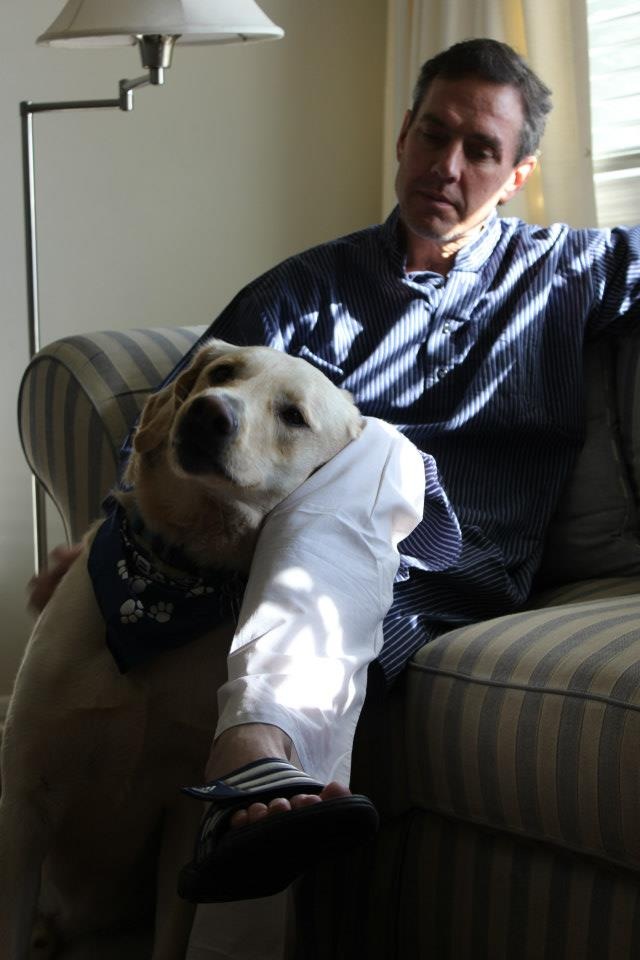
To put it very stereotypically, Sean was the quintessential male who was getting a dog. Just before Sage came to us at 8 weeks, he would make arbitrary comments like ‘a dog is just that, a pet! I find it funny when people make it their children. They humanize them! That is ridiculous!’ He doesn’t come from necessarily a dog loving family, although they owned a dog when he was growing up. He dog sat for friends, but as a dog owner, he was a newbie. I heard him and stayed silent, not knowing what kind of owner he would turn out to be. Of one thing, I was certain, he wasn’t going to be an unkind one. I read up zillion books on puppies, dog training, dog ailments, fictional dog stories. I went back to my childhood favorite James Herriot. I rented Marley and Me to watch with the kids (and then did a lot of explaining to 4 year old Ryan – as Marley’s owners tried to conceive a baby) ! Finally, after thanksgiving, Sage was ready to come to us.

As Sage walked into our house diffidently, the three of us – my two children and I melted like ice cream on a hot summer day. Sean kept his distance so as not to ‘overwhelm’ the puppy. Finally, when he uttered ‘Hi there big guy!’ Sage looked up at the big, tall human, heard his deep voice, promptly rolled over on his back and presented his belly in complete submission. That continued for quite some time. A sighting of Sean and bam – tummy side up, little paws kicking in the air in total submission. I am sure the first few nights, Sean silently questioned our decision of bringing a puppy in the family. Sage squealed and cried and wanted the furry comfort of his mommy. I was a poor substitute. I carried his crate to the guest room, put it right next to the bed, let one of my arms dangle where he could sniff my fingers. That seemed to calm him. We both caught a few winks that way for about a week, till Sage started sleeping through the night.

image

The first few months were fun and frustrating. There were chewed furniture, there were accidents, there were sock stealing and sharp puppy teeth. Sean was loving but firm. And Sage was still….a dog, a pet. Then one fine morning, we decided to take our 8 month old scared dog to a dog park in an attempt to socialize him. It was a disaster from the start. Sage stood by us, tail between his legs, literally shaking. Sometimes he would peek his little nose to take a sniff and retreat quickly when another dog came by to say hello. In the meantime, a German Shepherd and a huge Mastiff mix got into a terrible fight resulting in a ripped ear and a bite on one of the owner’s arm. While this chaos ensued, we tried to make a hasty retreat. But Sean was apprehended by a pit bull who cornered the poor guy and started barking viciously at him. A transformation happened before my eyes. The runt of the litter, our scared puppy launched himself between the pit bull and his human. He didn’t bark back but he stood his ground and protected his ‘dad’. The owner of the pit bull ran up, apologizing profusely. The dog didn’t like people standing in front of a chain link fence. Sean was doing just that, it was ‘nothing personal’. We left, and needless to say, never went back to that particular dog park.

The relationship, however, between the dog and the man changed. I don’t know if I attribute the change towards that particular incident or the charm that Sage naturally possesses and it was simply a matter of time. All I can say, I witnessed a change in words and demeanor. Gone was the ‘pet’ owner, instead ‘dad’ took over. I overheard mumblings like ‘you are my boy! you are my good boy! Aren’t you my good boy?” as Sage’s belly got rubbed. Ryan was chastised with ‘leave your brother alone’ when he was too rough with the pup. I was found thus, “Go find your mummy! Where’s is your mummy, Sage?”

Today Sean is most certainly the prefered parent as he is the one responsible for walks, runs and playtime. Mom is the one responsible for heartworm pills, flea medication, and dreaded baths. As I see Sean walk around the yard, trimming bushes, sweeping the driveway, I know his white shadow is not far behind. Sage follows him with adoring gaze and a heart full of love. When Sean comes home, he waits patiently for his dad to get out of work clothes before he claims his share of attention. After the initial romp, those two are joined at the hip. Sage silently pads along with Sean, and flops down with a sigh where ever Sean settles. Often times the long snout peeks in through Sean’s hands to investigate the laptop dad is working on. Sean gives an absent-minded patting on his head, and Sage just disintegrates in happiness. He smiles widely, settles down at Sean’s feet, closes his eyes and lets out a sigh of contentment. As long his favorite man is by his side, all is right with the world. They play, run, converse or just commune silently. The mutual giving is a thing of beauty for me to witness. The adoration and the love are precious. Sage came into our lives for a reason, I know. He teaches us to love selflessly, without holding back.

Elton John wrote ‘Your Song’ for the love of his life. I hope he won’t mind if I use just a couple of his lines for both my son with four legs and his human dad because life is indeed wonderful since they are in the world. I don’t know whether humanizing an animal is good or bad, all I know that Sage has added immeasurable value to our lives. His patience, perseverance, unconditional love enrich our lives. In our tumultuous google calendar dictated life, he provides the gentle shade where we come to relax, and unwind. His non judgemental, loving presence is our comfort. Sean transformed from a dog owner to a daddy. I am not surprised. How can one not, when one is given unadulterated adoration for no reason other than simply being, just existing!

image

image

My love for Kolkata…inexplicable.


I can never sell Kolkata to people who show interest in touring India.

“Errr.. there is the Victoria Memorial, and the St. Paul’s Cathedral. The Maidan is a nice green expanse in the middle of the concrete jungle. And then there is the Ganga and Outram ghaat!” I stammer.

But we can’t boast of the Taj Mahal or the Khaju Raho temples, we don’t have the Lal Quilla or the Lake Palace, we don’t have the pristine Himalayas (unless you go to North Bengal) to lure tourists. Instead, we have bandhs (strikes) at the drop of a hat, we have traffic jams, we have terrible pollution and we have tall concrete buildings which, I feel, are suffocating the whole city. And we have terribly long summer. The pleasant winds bringing respite in the summer evenings, are halted by tall buildings that are choking the city slowly.

In my young and foolish days, I took up arms against those who dared to say a word against Kolkata. I was ready to break up with my boy friend who dared criticize my city. I got this passion from my fire-brand mother, who brain washed me from an early age “east or west, Kolkata is the best”. Yeah, she is very parochial. I inherited that mentality from her and kept the fire of nationalistic pride ignited in my heart. My friends too, were die-hard Kolkata fans and believed that only us, the Kolkata lovers, had the right to criticize our city but heaven have mercy on those outsiders, who dared utter a word against it.

Those days are gone. I am a wise, mature woman now who left Kolkata in the mid nineties and never went back to stay. I learned, in due course, that criticizing something/ someone doesn’t mean loving it less. It means we acknowledge a problem and that is a first step towards looking for a solution. That also means something/someone does not have to be blemish free for us to love, we can love something/someone warts and all.

I wonder sometimes why I love the city like the way I do. Does distance make it easier to love Kolkata? Why does the city invoke such a passionate need in me to protect it from outsider’s disdain? Objectively speaking, what exactly is going for the city of Kolkata? Am I really protecting the city or am I safe guarding the memories that the city and I have built together? I still get teary eyed when I listen to Kabir Suman’s

“Ei shohor jaane amar prothom shob kichu
Palate chai joto she aashe amar pichu pichu”

This city knows my every ‘first’
It comes after me, no matter how far I go from it.

It is not the brick, mortar cement of the city that I love, but the faces, the love, the blessings, the friendships, the heartbreak, the experiences that slowly and lovingly molded me, created ‘me’ and shaped me to the person I turned out to be. It is a very personal kind of love that I have for Kolkata.

Those of you who read my blogs know by now, I am a big believer of living in the moments. I have grown up and moved away but whenever I think back to my home city, the moments and memories of my past crowd around me. The sound of Indian classical music coming from the different houses in the neighborhood as the little girls sat down with their harmonium to practice music every evening, the smell of meat cooking only on Sundays in our middle class neighborhood, the communal ‘antakshari’ game on our respective balconies during daily power cuts, the collective sound of ‘Aaahhhh’ when the lights came back on. There are unpleasant memories too but those don’t surface in my mind much. I have lived through them, and left them behind. I came away with the beautiful ones.

I am going home in a few weeks (still over a month left but the time remaining seems shorter if I talk in weeks, hence….)! Friends ask me what are you going to do when you go back? Do? I will do absolutely nothing. I will lay in our king size family bed, next to my mother and talk. Or not. We will probably read or listen to our favorite songs. I am looking forward to those moments of easy silence next to the person who I still want when I am sad or don’t feel well. I will accompany my father to Gariahat market and hear him proudly say to the fishseller ‘Shob cheye bhalo mach ta dao dekhi. Meye esheche.’ (Give us the best fish, my daughter has come) ! I will cherish his ways of showing love – by buying the tastiest fish, the choicest mangoes, the tenderest meat and the satisfaction in his face when I exclaim how good everything is.

I am not sure if this is true for every immigrant. The thing that I miss most about home is the familiarity. I miss the shared history. I love my adopted land but I am not familiar with the tv shows of the seventies, or the baseball players of yester years. When my contemporaries exclaim about how much they loved a certain show growing up and turn to me and say, ‘Remember?’ I say, ‘No, I don’t!’ I remember Humlog and Fauji and Sunil Gavaskar and East Bengal Mohanbagan rivalry.

I will immerse myself in all that familiarity, all the love for two weeks and come back with enough memories to sustain me in the coming year. The greetings of the neighborhood boys, the smiling faces of my aunts and uncles, the welcome from my friends are my personal treasures. They are the city’s love for me which I can’t show an outsiders. They belong to me and to those who can still feel the love.

image

image

‘Let’s do something for the Underprivileged’


Parents cease to be infallible to children once they cross the magic years of childhood and enter the murky waters of preteen. It is a confusing age, an age where the boundaries that parents set seem cruel, meaningless and restraining. Parents become the beloved jailers, loved in many ways but hated in some. I felt the same way towards mine while growing up yet at some level, I always knew two well-meaning, kind-hearted people who gave birth to me have also bequeathed me their legacy – kindness.

As a child, I have seen my father spend hours next to his aging, bed ridden relative by marriage, listening to his tales of yester year glories. His gift to the lonely old man was a patient ear and his time. He was, and still is, the hero and savior to all stray dogs and cats in our neighborhood. He instilled in me the life long love for animals. My mother, not only indulged me in all kinds of madness with animals, which included, but wasn’t limited to assisting my cats birth their kittens on my bed and saving and nurturing countless dogs and cats during my entire childhood. She turned a blind eye as I donated generous portions of family rations to alm seekers who knocked on our door. Well, she couldn’t have stopped me anyway. I still remember witnessing the tears in the eyes of our domestic help as she took off her gold earrings and gave them to her for her daughter’s marriage.

After I grew and moved away, my parents found a sudden void in their lives. With me gone, they suddenly did not know what to do. Their lives revolved around our visits to them and vice versa. Then came the grandchildren. Their joy multiplied, but when it was time for us to part, so did loneliness. They waited for phone calls, visits. Life became a long wait.

My father, possessing an inquisitive mind, started tinkering with my old computer. He taught himself enough to land in his first social networking site – Orkut. After a first few shaky steps, he discovered a different world in there – one of online friendship. He dragged my reluctant mother into this and an addiction was formed. My mother came into social networking kicking and screaming, but she was fascinated by the expansiveness of the world it presented. The barriers of sex, age, caste, creed fell away. Her gregarious, jovial and spirited self was just perfect to attract a large number of online friends. They both started spending hours interacting with individuals they knew through Orkut and Facebook, exchanging ideas, talking about Tagores’ poetry, quotations, songs. Gone were the days of lonely sighs and long waits. Life took on a different meaning.

I was happy at the distraction the social networking site provided since I suffered from the single child guilt. At the same time I was alarmed at this addiction which I feared may take a toll on their health. Well, I was wrong and how!

Hours of chat on Facebook gave birth among some like-minded friends, the desire to do something for those in the lower strata of the society. They talked, discussed, debated, planned for hours and created a community called:

LET’S DO SOMETHING FOR THE UNDERPRIVILEGED

Their ultimate goal is to reach a position where they can help people change their lives. They are not there yet but they have put some precious smiles on some precious faces. They have collected money and given out school supplies to elementary school children in slums of Kolkata, India. They are planning their next project, which is to donate clothes to the needy before the biggest festival of Bengalis – Durga pujo. They have pooled their own resources but they can not help as many people as they want without donations. So they are reaching out to you to help their cause by donating money/ time to help their efforts.

I humbly ask you to please visit their Facebook page at https://www.facebook.com/LetsDoSomethingForTheUnprivileged.

See what they are all about. If you like their initiative, please like their Facebook page to tell your friends about this community. If you are able, please donate money and/or your time. If you are local, feel free to join in their efforts and further their cause in bringing a change. They are a group of well-meaning people but new at this venture. They will certainly benefit from your advice and expertise. I request you to know this community and support their efforts in any way you can.

I am immensely proud of my parents that instead of looking inwards in their twilight years, they finally found the time to do what they wanted to do all their lives (and did in small ways) – give back to the community. I am thankful they found a group of friends who share their zeal to make a difference, no matter, how little. I salute this endeavor and I hope they will continue to grow and become a bigger organization to help more and more people in their community and beyond. I also hope you will join me in giving them the support they need.

Daddy’s little girl.


Sean had to travel all over South Asia when Sahana was a baby. But the precious little time he had with her, there was no one else in his universe but his baby girl. I was relegated to the periphery, where I gladly retired for a while, looking in, smiling as I saw the two of them play, laugh, giggle, sing, tickle.

Every Saturday, Sean took Sahana with him to the American club to play basketball, swim in the pool, play in the playground, eat pizza and then return home in the late afternoon. Saturdays were my days off from child rearing. I was free to focus on myself, go out for lunch with girlfriends, read and realize, ‘oh goodness, I am not just a mother, I am a woman as well!’ But most afternoons found me hanging out in the balcony, craning my neck to see the cream Ambassador car that brought my baby and my husband home. I loved my ‘me time’ but in small doses.

Daddy was a source of joy. Mommy was needed for comfort and sleep. Our roles, in Sahana’s life, were very well defined. And we reveled in our roles. I was the story teller, the book reader, the lullaby singer. Daddy was the fellow climber in the jungle gym, the reassuring presence in swimming pool, the instigator in challenging hikes and creek crossings and lastly, the strong pair of arms when little legs got tired.

After we moved to United States and Sahana got a little older, Sean took her out on daddy and Sahana dates. Five year old Sahana got dressed up, walked up to the car, Sean held the car door for her. Strapped her in and off they went. There were nights of hot chocolates and incessant chatter, which I was made aware of later, by the laughing father.

The five year old is a teenager now. The chatter about ‘what ifs’ is replaced by debates – on everything under the sun, ranging from theology to the grungy sweatshirt that she insists on wearing to school. The date nights have been replaced by softball games and swim team practices, Shakespeare seminars and memory book committee meetings. There is hardly any time. Often, there are eye rolls and exasperated sighs and ‘you just don’t get it’ directed at dad. Often they come to logger heads because both are similar. But on rare occasions, when a few rational moments dawn on Sahana, she tells me:

‘Dad has really set the standards high for me! How will I ever find a man like him who will treat me like he treats you? Do they even make men like him any more?’

We don’t always consider what a tremendous influence we are on our young ones. Fathers play such an important role to shape the idea of what a man should be, as their little girls look up to them with awe filled, adoring eyes. Fathers set the tone for the behavior a girl should come to expect from her life partner. Fathers teach the important lesson of self worth to their daughters. They teach their daughters that they are not defined by their body shape, their hair style, their clothes or their looks. Mothers teach the same, but dads, being of the opposite gender have more impact on the little girl psyche. They are, instead, defined by their qualities and the values that they carry to adulthood. Fathers reinstate the faith in their daughters that they are important, they are worthy, they are intelligent and they have as much right to the air and sunshine in this world as their male counterparts. Fathers teach their daughters to throw like a girl and be proud of it. Fathers tell their girls to be confident of their worth, stand up against abuse and violence directed against them, to take risks, challenge themselves, go one step further. Fathers show, by example, that their little girls should expect to be treated with respect, kindness, love and she should give the same back in return.

At the end of the day, despite the eye rolls, despite the frustrated sighs, despite the heated debates, daddy’s little girl will always know in her heart that those strong hands that picked her up when her little legs got tired, are still her safety nets. Not just in swimming pools, or play grounds any more, but in the vast journey through a rugged terrain, that is called life.

IMG_8502

What I wrote in this blog, unfortunately, is not the reality. It is more what my idea of a father’s role should be. Sahana, and some fortunate ones like her, have a strong, positive male influence in their lives to boost their confidence and emerge in this world as confident young women, who are aware of what they deserve. They are also aware of the age old adage ‘do unto others as you would have them do to you’! If all men treated their daughters like the way they should be treated, it would be a perfect world. But they don’t, and it is not. Hence Tracy Chapman writes:

“Why is a woman still not safe
When she is in her home?’

Indeed! Why not? When? Isn’t that the million dollar question?

Vacation


The act of getting my family out of the door is blog worthy in itself. Sean zooms around the house with an air of ‘oh I am so responsible for the security of this house’, closing a flap here, a door there. Ryan clutches on to his minuscule star war figure (please don’t ask me which one, because I am that kind of a human who confuses Star wars with Star Trek, causing fans to shudder) and lazes around with no sense of urgency, whatsoever. Sahana, dons her tattered boots and shoves her little journal and pen IN her boots, and settles down on the couch with a deep, thought provoking book like Inferno or Dr. Faustus. That kid is weird, and I like her. I purposefully walk into a room and promptly forget why I came in in the first place because mentally I am checking the mile long list of little things that can preempt any kind of disaster like sore throat or upset stomach or a 102 fever. Once we are ready to go, Sean runs in to do one more thing that needs to be done. When he comes out, I run in because I forgot my waterbottle. And when I come out, the kids run in, either to go the bathroom, or because the answer to ‘do you have your coat?’ was a subdued ‘nooooo!’ Yes, we are predictable! And if Jerome K. Jerome was alive, he would have written a wonderful short story about us.

That is exactly how it panned out before our car trip to Williamsburg, Virginia. Finally, the seatbelts were clicked, the ignition turned on, my shoes were off, feet on the dashboard and we were on our way. Right away, there was a major disagreement over the choice of music – Dixie Chicks or Veggie Tales, which I squelched with ‘You guys settle down….or else…’ threat. Peace prevailed for a couple of hours till:

‘I need to go to the bathroom, NOW!’ – Ryan’s plaintive voice.

At that moment, we were sitting in traffic on I 495 south with long serpentine line of cars ahead, moving at snail’s pace.

‘Daddyyyyyy, I need to go the BATHROOM!’

‘Ok, buddy! I will try to find one, as soon as I can!’

After some whimpering and crying and moaning and requesting his helpless parents, Ryan got angry and resentful. This is how he is going to take revenge on us for not helping him out in his present state of discomfort:

‘When I am older and you guys are too old to drive, I am going to drive you guys around and not stop at a bathroom when you guys need to go!’

Sean and I, looking desperately for a hole in traffic to get to an exit, exchanged glances, trying hard not to laugh out loud….fearing our fate in old age!

Long story short, we got off at the nearest exit after many more tears and oohs and ouches. We found a bathroom. Ryan emerged after doing his business with a huge toothless smile, the relief on his face was palpable. We got hopelessly lost and completed the 3 hour trip in 5 and a half hours.

There were some moments when I shook my head and wondered why we bothered. There were some fights, sibling rivalry, some shoves and pushes and temper tantrums. But those were few compared to the skipping, jumping, tinkling laughter, camaraderie and sibling love.

At Busch Gardens, I was dragged kicking and screaming to ride the Lochness monster so that we could tell posterity that we rode that horrendously scary ride as a family. I planned to be an observer of the jollity at the amusement park and use the excuse of my camera to get out of riding scary rides. The plan failed. A locker was found, our stuff was stuffed and I was, very unwillingly, dragged to the rides. I screamed myself hoarse – a happy scream. And felt very daring and brave afterwards as I stood there watching people go up high and get dashed to the ground…just about. I wondered who was having more fun going on the rides – Sean or Ryan. Sean tried to use the fearless Ryan as his pretext to get on each and every ride ‘A grown up must accompany Ry, so I have got to go, you see!’ When Ryan was barred from going on the scariest ride, the Griffon, due to his height, Sean’s ruse failed. He admitted, he would go on it by himself and would I care to join him….for love. I gave him a kiss and told him I loved him, but not enough to get on a ride that is described as such in Wikipedia:

Ride Elements

205-foot 90° drop
146-foot (45 m) Immelmann
130-foot 87° drop
100-foot (30 m) Immelmann
Splashdown finale
360° Climbing carousel turn

It takes one up 205 feet, goes over the edge for a few seconds so one can look straight down 90 degree drop, before it plummets down, 70 miles an hour. And that is the beginning of several twists and turns.

He went alone. And came back exhilarated.

Sahana made it a point to mention to me every time I wanted to take a picture that “You guys are such tourists. I hate tourists!” My response to that was “Be quiet and go stand next to your brother!” She went with a slight grin on her face and reiterated that she hated such touristy behavior. We did the tour of James Town, lunched by the beautiful York River, strolled the historic lanes of Williamsburg, went on a guided tour of “Ghosts among us” and heard stories of vampires, cannibals and ghosts that supposedly frequented and still haunt the streets and mansions of Williamsburg. We played mini golf and ate ice cream. We laughed and teased and hugged each other.

As the children ran ahead of us, excited at things they saw, chattering happily, Sean and I looked at them and realized a few things. First, they are growing up way too fast. Life is going by us and we aren’t making much of an effort to stop time to enjoy the moment, we are too caught up in meeting deadlines, working, taking them to structured activities, paying bills, worrying about their future. We sometimes forget to enjoy the present because we are doggedly focused on their future. A little time outside the structured life we lead, gives us the chance to really see them, as the little humans that they are becoming.

The vacation wasn’t perfect. We are not a perfect family with well behaved kids and smiling, patient parents like they show on television. There were moments, as I said, when I wonderer if going away is really worth it. Sahana’s temper flared, Ryan whined and whined to buy a toy gun. Sean almost made Ryan go to bed without dinner for bad behavior, I yelled at them to stop fighting. But those moments have already been shut down in a tiny, little compartment in my head. The moments that I will air out and smile upon are the brilliant, happy smile of my thirteen year old Sahana, constantly scribbling quotations in her little journal, toothless laughter of young Ryan after riding the Lochness monster, the beaming face of my husband, who posseses the ability to have most fun in any vacation. I can cope with my regular, google calendar dictated life for a while. The happy moments will see me through. When dark clouds start gathering in the horizon, I will need to pack up my little family, and get away again, to regroup and rejuvenate, to bond and to be part of some meaningful experience – together.

Incredible! In more ways than one.


Recently, I watched a movie The Best Exotic Marigold hotel where a group of elderly British people make a conscious choice to live their golden days in a retirement facility in Jaipur, India. They all have their unique reasons for doing so – one goes to get a hip replacement, one goes looking for lost love, one goes due to financial difficulties. But the movie is not the reason I decided to write the blog. It is because of all the memories the movie brought back. Memories of incidents, memories of people who came in our lives for a brief time. Incidents that made me fill up with inexplicable pride that I was born in India, incidents that made me enraged over the cunning of some of my fellowmen, incidents that made me indignant against how, many in my country, were treated, incidents that made me want to hide my face in shame, and incidents that made my heart melt at the show of human kindness.

Sean and I hosted many friends and family from the United States during our six-year stint in New Delhi. The movie brought back memories of how India can be a complete onslaught on an individual’s senses. Nothing can prepare one for the country. No matter how many tour books one reads, how many videos one watches, one can’t comprehend India unless one has felt the full-fledged blast of the country on one’s sensory organs at arrival. The smell, the explosion of colors, the multitude of people, the complete disregard for personal space, the honking cars, the errant cows, the street dogs, the weaving auto rikshaws, the little make shift shops along the road – the little composites of the larger picture. And hidden within the chaos is the amazing sunset over the river Ganges in Varanasi, the silhouette of a fisherman’s boat drifting idly on the Hooghly river as the sun sets over the horizon, the tiny little nameless flower growing from the crack in a concrete within the moldy buildings of a city, the kind auto driver advising me, like one of my own, to give a warm bath to my rain drenched children as soon as I get home, so they don’t catch a cold.

The question that friends and family asked me often was, how did we deal with the abject poverty staring right at us, wherever we went. My brother-in-law was very disturbed by the people, little children and elderly folks, begging on the streets. I said ‘We have to learn to look past them because it is impossible for us to help each individual that accost us! You have to ignore them, develop a slightly clinical detachment or else, their sorrow will engulf you!” He said, “I can’t. I simply can not!” At the end of his visit, the poverty, especially the little children begging on the streets wore him down. I remember him breaking down in tears after sitting at the train station in Agra, surrounded by little children asking him for money, food!

I realized, after watching the movie, how bewildering India must have seemed to the visitors who came to tour. Living in the midst of the chaos, I didn’t completely empathize with my guests. While they shuddered at the sight of little, scrawny children hitting the window of our air-conditioned car in the hope of money, I nonchalantly talked on about the sight-seeing I had planned for them or the place I intended to take them for dinner. Their focus was somewhere else, I realize now. Since I lived with the problem, it ceased to be one, for me.

Sean developed his unique way of dealing with beggars during his eight year stay in Kolkata and Delhi. When elderly beggars asked for alms, he folded his hands and bent his head – the Indian gesture of Namaste. As they insisted, he smiled and did the namaste again. With children, he established a relationship by either juggling (he does juggle relatively well) or making funny faces or asking them their name in atrocious Hindi. The result was unadulterated, joyful laughter. The white man playing the fool. It never failed to elicit a smile, a laugh.

Every Saturday, we went to the American club where we played sports, ate pizza and swam. At a traffic light, about 5-7 children ran to the cars asking for money or food. They were led by a wild haired, young girl of about 12. She managed the kids, led them to the cars and when the lights changed led them safely back to the sidewalk. But it always made us nervous to see them weave between the chaotic traffic. They came to our car as well. Sean rolled down his window and shook their hands, I smiled and baby Sahana gave them toothy grins from her car seat in the back. One very hot summer afternoon, Sean offered the wilting children his water bottle filled with Gatorade. The faces were worth watching. They had expected plain water but what they tasted was so much better, what a treat. From then on, it was not money they wanted but “Bhaiya paani, paani” (brother, water, water)! We started carrying extra bottles of Gatorade to share. They drank quickly while the light was red, passed on the bottles to us as the light changed and swiftly moved back to safety as the cars started moving. The girl made sure each child was safe. She did a lot of talking and laughing, all in Hindi. Sean responded with a big grin and some broken Hindi. Neither understood what was being said. I smiled at the exchange.

A couple of days after Rakhi, the girl brought a rakhi to our stopped car and tied it around Sean’s wrist. Rakhi is a beautiful festival celebrating love between a brother and a sister. Sisters tie strings around their brothers’ wrist wishing long life and happiness. Brothers swear to protect their sisters. I won’t go into the whole spiel of gender discrimination here. Suffice it to say it is a festival of love, the intentions behind are beautiful and good. Anyway, Sean was touched beyond words. We didn’t have anything to give her. So the next time we met Sean got her a warm, soft shawl to keep her warm during Delhi’s bitter cold. She touched the shawl in delight and felt the softness against her cheek. “Accha hai, bhaiya!” (Its good, brother) and ran away as the light turned green.

We continued to see her and her charges for the next few months that we lived in Delhi. We never saw her wearing the shawl ever and wondered if she got to keep it, after all. Then we left Delhi…..and I forgot about her. Till I saw the movie, and the young wild haired girl came back to my mind. Now I don’t stop thinking about her. I wonder how she fared. Did she find happiness or is she still roaming the streets, begging or selling….herself?

Woman’s day! What does that mean to you?


I was invited by a friend, director of an AIDS hospice, to speak to a room full of women on Women’s day, some years back. I wasn’t the intended speaker, Sean was. I was just a tag along. After Sean spoke, the director of the hospice, our friend, came towards me with a big smile on her face. “Say something. As a woman, to all these women!” she said. With cold clammy hands and sweat dripping down my shirt, I walked towards the lectern, my mind racing. I was the undeserving cynosure of at least 50 pair of eyes. By accident of birth, I was on the other side of the lectern. My family’s expectations from me were degree, job, good marriage, a happy life, in that order. They worked hard to get that for me. I didn’t have to struggle to achieve anything. The women sitting in front with hopeful faces, however, were tested by fire. Former sex workers, rape victims, wives of HIV positive men, who unknowingly carried the deadly virus, paying a hard price for their errant husbands’ vices, former drug users. Poverty, lack of education, and squalid living conditions led them to desperate measures. Yet they did not give up the battle to have a shot at a better life. They were fighting tooth and nail, they were staying afloat, they were gasping and struggling, yet holding on. Despite their sickness, they were trying to carve out a decent life for themselves, and some, for their HIV positive children. So that is what I told them. I told them they were inspirations to me, to be a better person, a better mother, a better daughter, a better wife. I vowed, like them, I would never give up, no matter how hard the going gets. From them I learned never to disregard or take for granted the chance that I got in life just because of an accident of birth.

My grandmother studied till the 10th standard. My mother married a man of her choice in her first year of college. She finished her graduation when I was six years old. I, however, was expected to not only finish college but study further, get a job and then think of marriage. There has been a linear progression among the women in my family. That is symbolic of the state of women throughout the world. There has been progress, definitely. But has our gender found equal footing with men? Not yet. We are a work in progress, we are still paving the highway to reach our destination – equality. Many are hard at work, some are, perhaps, way back in line but they are moving – forward. Women’s Day celebration bothers many enlightened women. This whole concept of Woman’s Day irks me too. Me, a privileged, respected, somewhat enlightened woman living in an equal partnership with a man. The history of Woman’s day doesn’t reek of discrimination though. Instead, it represents the unity of the working women. According to Wikipedia, International Women’s Day

“Started as a Socialist political event, the holiday blended in the culture of many countries, primarily Eastern Europe, Russia, and the former Soviet bloc. In some regions, the day lost its political flavor, and became simply an occasion for men to express their love for women in a way somewhat similar to a mixture of Mother’s Day and Valentine’s Day. In other regions, however, the original political and human rights theme designated by the United Nations runs strong, and political and social awareness of the struggles of women worldwide are brought out and examined in a hopeful manner.”

I personally don’t want to have a day dedicated to my gender. I, and many others like me, don’t feel inferior to the other gender in any way and dedicating a day for women is actually demeaning. It is like pointing out that you are weak, it is patronizing and as I said before, it reeks of gender inequality. But I am not one of those multitudes who are struggling against social stigma or religious conservatism. I am not the girl whose mother tells me it is a sin among their ‘beradari’ (clan) to send a girl child to school. Only boys are worthy of education. A girl child is only good for marriage – sold, in other words, at a steep price. I am not the woman who is getting beaten up by her husband every night in his drunken stupor because she fell asleep before he came home. Celebrating Women’s Day by buying a Hall mark card is not going to help the sweet girl who swept my house with her mother or the woman who hid her scar the next morning, accepting the abuse as her fate. But raising awareness about their condition might help them. Wishing other women ‘Happy women’s day’ on Facebook, for me, is completely meaningless. How about we make a resolution on this day to champion a cause that is close to our heart. Maybe sponsor the education of the daughter of our domestic help, or her son, for that matter? How about teaching the children of sex workers so they can break out of the vicious cycle? How about volunteering at a women’s shelter, how about donating money to a reputed Non Government Organization (NGO) who work towards women’s empowerment? Why not be the change that we want to happen instead of being an armchair analyst and either condemning Women’s Day or doing mere lip service by wishing another woman ‘Happy woman’s day’. What does Happy Woman’s Day mean anyway? Should we be happy that we are struggling and working hard to be counted as equals – like a world-wide sorority, working towards a common cause? Should we be happy that a few of us lucked out and got ahead of the game? Are our sister in remote parts of Africa, Latin America, Asia happy that they are part of this sorority? Do they even know?

I apologize if this blog seems preachy or didactic. That is not the intention. What right do I have to tell the world what they should do on this day? None, whatsoever. Sean and I make our meager contribution to women’s cause and other cause that are important to us and keep the faith that every little bit counts. I only want to share some ideas on what I think celebration of Women’s Day should be. I am fortunate to know so many people who are working hard and dedicating their time and energy in empowering women by providing education, healthcare, by helping them start cooperatives and little businesses. I have seen some of the fruits of their labor and have been amazed and humbled by these workers’ tenacity and relentless desire to make a change in another’s life. They talk less and work more. They motivate me to do my share in helping another – like trying to sponsor the education of a young woman of limited means. She didn’t want to continue her education so I put that money in her bank account so she could have a nest egg when she went into marriage. She is happy and expecting her first child. I hope one day she will use the money towards the education of her child. Today I made a resolution to help a woman who tried to kill herself by setting fire on her body because she couldn’t suffer her husband’s abuse anymore. She lived, but badly scarred. She is twenty years old, she hardly ever goes out and never takes the cover off her face to hide her scars and her shame. I will write about her and ask for your advice about how to go about helping her. I don’t need your money just your thoughts, a collective brainstorming of sorts.

Celebrating Women’s day is important I think. A day to raise awareness of the struggle that many women face everyday in any sphere of her life. Unfortunately, some women begin their struggle right in their mother’s womb. A struggle to live. At the same time, I hope and pray that during my daughter’s lifetime there will be no need to celebrate a day dedicated to her gender. And I tell her and her brother, whenever the occasion arises, that both of them have equal rights to the air and the sunlight they receive. Hopefully they will pass on that message to their children. But right now, the majority of women all over the world are playing catch up. Although, changes have been made, yet anybody who does humanitarian assistance work will agree that lot needs to be done to bring women up to speed. Dedicating one day to women can actually make people pause and take notice.

Let us each vow on this Women’s day to do at least something. At least, reiterate again and again to our children, nieces and nephews, students and grandkids about respecting other individuals. Let us stop using demeaning words and phrases against women, against different races, against people who may be different from us. It is so easy to do. Let us just think before we speak. Let us think of the repercussions of our words on others. And eventually, one day, during our children’s life time, men will not feel the need to insert an iron rod inside a woman to ‘teach her a lesson’ because she spoke out against wrong doing.

Lets keep the faith. It can happen.