Off to visit the Mayans – Day 2, Uxmal.


The second day started with Ryan loudly ‘whispering’ to Sean at the crack of dawn, ‘Dad, Dad, I am really, really hungry!!’ And when Ryan is hungry, he is worse than Eric Carle’s ‘The very hungry caterpillar’. We got up and pattered around the room, getting ready for the day. The parents tried to be quiet to let Sahana sleep a while longer while Ryan tried to make as much noise as possible to wake her up! Soon enough, we heard a dying pterodactyl groan from under the covers:

‘It is 6:30 in the morning!! Why are you all walking around?? Why are you even awake? I disown all three of you! Let me sleep!!’

Sahana groaned and moaned while the wicked brother giggled and chuckled. Finally, she got out of bed just to tackle him to the ground for being a pest, got ready and came down to breakfast with us.

After a breakfast of huevos (eggs), beans, cereals, papaya, banana and cafe (for me), we slung our bag packs on our shoulders, went to find our vehicle Escargot and embarked upon our journey to Uxmal – 67 Kms away. And this is the gift we received for our endeavor.

image

As Escargot ate up the kilometers on an empty two lane highway, all four of us quietly basked in the beauty of the sun kissed day, the young, verdant green creating a foliage over our heads, the occasional farmer by the road tending to his own farm. The journey took us less than an hour and a half to get to Uxmal, which, in Sean’s opinion was the best of them all. Sean had visited the same area twenty five years ago as a young backpacker.

I got my camera out as we entered the site but the children forgot about the pyramids because they met him……or her. I really can’t be sure.

image

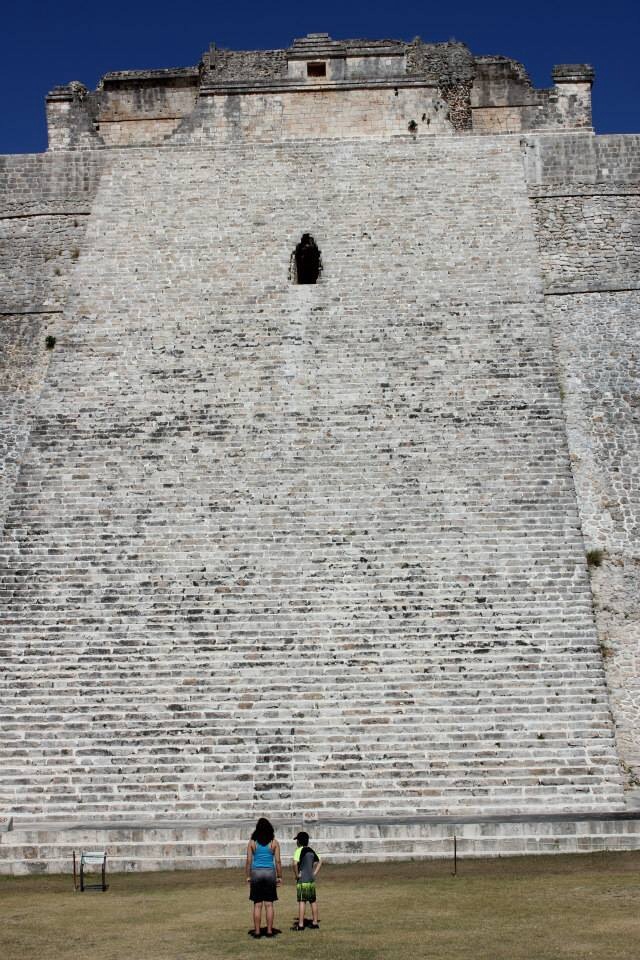
We named him/her Sultan/a. The iguana population distracted Ryan and Sahana while I stood in front of this with my mouth open.

image

And to put the size in perspective

image

The Pyramid of the Soothsayer, also called The pyramid of the Sorcerer.

I think the legend associated with the pyramid is most interesting. An alux (aloosh) is a creature with a body of a baby and the face of an old man born out of egg. The common belief was (probably the folklore still exists) that these were spirits of old gods driven away from temples, taking revenge on non-Yucetecs. The legend, according to ‘Yucatan & Mayan Mexico’ goes something like this:

When the story began, Uxmal was a humble place, with nothing like the grandeur it later attained. It was ruled over by an old King who lived in the fear of prophecy that he would be dethroned by a new lord, a dwarf, and this lord would herald his arrival by beating on a drum. Now, there also lived a woman, a witch, who did not have any children but pined for one. She found an iguana egg, which she brought back home and cared for. Eventually a baby was born out of that egg. The baby could speak as soon as he was born but stopped growing after a year of his birth. He was an alux, the Dwarf. One day he found a drum and started beating. Panicked, the king sent his army to capture the drum beater and be brought to him. The king set the dwarf some seemingly impossible tasks, which the dwarf agreed to do provided the king matched his efforts. The king challenged the dwarf to build a house overnight that had to be higher than any house in Uxmal – which the dwarf accomplished. The Pyramid of the Sorcerer was built overnight thus. Finally, the crucial test was them both hitting each other with giant hammer. The Dwarf’s mother placed a magical tortilla on her son’s head but the king’s head was unprotected and therefore smashed. The Dwarf became the new ruler and the prophecy was fulfilled.

Although Uxmal has several glyph inscriptions and stelae, they have not provided a complete history of the region like Palenque. There is a lot of information on the history of Uxmal and the architecture of the Puuc region but since the blog post is a personal journal, I will steer clear of facts and history. Due to the number of visitors, they do not allow climbing on the Pyramid of the Sorcerer anymore. However, one can still climb the steep steps of the Temple of the Mayor and enjoy the view atop the monument. One can see the sweeping vista of the ruins and the terrain adjoining the ruins. The day we chose to travel to Uxmal, the sky was blinding blue, the sun was sweet and strong and we truly felt at the top of the world as we gazed far out from top of the The Tempelo Mayor.

image

Climbing up the Temple of the Mayor.

By the time we explored the big structures, went up and down the Temple of the Mayor, the children were hot and tired. Even the iguanas seemed to lose their capacity to entertain. So we brought them back to the entrance, sat them down in the shade, bought them ice cream, handed them water bottles as well as our backpacks and like any responsible parent, we took off with a reassuring ‘Stay here, we will be right back!’ (Please do not call child services on me, they are older and responsible enough to be left alone 🙂 )! There were a few sections we had not explored and Sean and I are that type of curious people who like to see it all!

Uxmal was magnificent, the day was glorious. It was less touristy and Uxmal had a grandeur that demanded respect and awe. The relative silence of the place let us do just that. We looked up at the monuments in awe and marveled at the ingenuity, depth of astronomical knowledge, artistry and vision of the ancient Mayans.

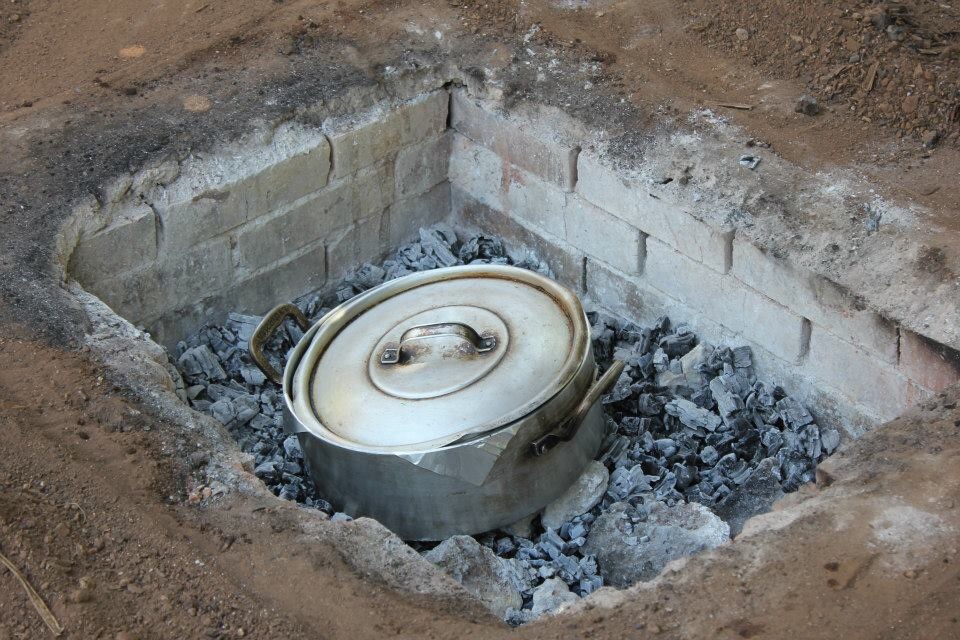
I turned around and bade farewell to the majestic temples and sites of Uxmal as Escargot got on the road to take us back to Merida. But stomachs were growling at this point and lunch seemed imperative. On the way back, we discovered a thatch roofed (palapas) restaurant, more like the roadside Dhabas in India and we decided to pull in. That turned out to be one of the best decisions we made on this trip. The staff was simply wonderful, very cheerful and proud of their heritage and cuisine. Our server took us back to their garden and showed us the chillies and other vegetables that they grew themselves. And then he showed us the typical regional way of cooking meat – Pibil. They put the meat – chicken, pork, beef with seasoning in a stainless steel container and buried it underground and cooked it for hours. He took out a container while we watched. The meat was so tender it seemed to be falling off the bone. I, of course, ordered that.
image

image

Uxmal, the day, the food, the people – all of these made me so deliriously happy that I wanted to convey to the world and especially to the nice staff of the restaurant how wonderful everything was. The trouble was , I wanted to convey all this in their own language!! The delightful joint thrilled me so much that I unknowingly brought in rudimentary French in my very, very broken Spanish as I tried to bond with our server. I got embarrassed nudges from my daughter as I said ‘moi’ instead of ‘mi’ and ‘tres bien’ instead of ‘muy bien’ .

‘Mama!!! That is French!’ She whispered. Typical teenage embarrassment over parental faux pas.

‘Shush!’ I said, undeterred. ‘Both are romance languages.’

And continued the communication with a lot of smiles, hand gestures and Franish (French/Spanish). The server and I did just fine! While I bonded, Sahana nudged and Sean smiled, Ryan sipped his Coca cola and kept sticking his tongue out saying, “I am drunk!”

The afternoon found me by the poolside writing in my journal, Ryan splashing in the water, Sahana sunbathing and Sean snoozing in the hotel room. The plan in the evening was to explore Merida. After the sun set and the heat lessened we walked around the capital city of Yucatan, Merida. It is a quaint city, with interesting architecture of vibrant hues. Bright pinks, fluorescent yellows, strong greens, deep blues on buildings seemed to work very well in that city. I loved the brick streets, the parks, the beautiful cathedral, the call of the friendly hawkers, “Amigo, almost free!”

image

We came back to the hotel after dinner and went straight to bed. Day 3 would take us to Chichen Itza and then southward bound to the beaches of Cancun, Playa Del Carmen and Akumal.

Sore finger continues to swell, continues to throb, continues to change colors in different shades of unhealthy green. But ‘after all, tomorrow is another day’…

Amor! Some call her Roma! Day four.


On my fourth morning in Rome, I was nervous. I had the map laid out on the hotel bed and was tracing my fingers across the unfamiliar sounding names of serpentine streets. The plan was to see the Basilica di San Clemente at Laterno and the Basilica of San Pietro in Vincoli (St. Peter in chains)! I knew it was very close to the Colosseum so walked confidently towards the impressive amphitheater, standing proudly against a cobalt blue sky. I opened my map up in front of it. After giving myself five minutes of peering cluelessly at the streets on the map, folded it carefully, put it back in my pocketbook and went to the first policeman I found.

“Scuzi, senor, how get to Basilica di San Clemente?” I constantly spoke terrible English during my stay in Rome. For some reason, I felt if I dropped some words, I may be able to communicate better!!!

The policeman answered back in accented but perfect English, pointing me in the right direction. I stopped to look at the ruins of Ludus Magnus, a gym for training gladiators. Archaeologists believe there was a network of corridors that linked this structure to the Colosseum.

The Basilica di San Clemente at Laterno was tucked in a narrow lane. This basilica was dedicated to Saint Clement, the fourth pople, making this one of the oldest Roman basilicas. Ruined in 1084, it was rebuilt on the same site by Paschal II in 1108. I entered the Capella di Santa Caterina (St. Catherine’s Chapel) which has some decorative frescoes by Masolino de Panicale (1383 – 1447). This is a prime example of of a church piled atop a church piled atop a pagan temple. A 12th century church was built directly over a 4th century church, which was built directly over a 2nd century pagan temple. This kind of architecture is not unique in Rome since almost the entire city is built directly on top of the ancient one. In San Clemente, one can actually go down to the lower levels and get a glimpse of the city’s architecture in the 2nd century. 2nd century!!!! How incredible is that?

I had to buy a ticket (5 euros) to go into the lower basilica. The lower church was dated back to the 4th century and still has some relatively well-preserved frescoes. The base of the building dates thousands of years back in time. It corresponds to a 2nd century house in which a Mithraeum was created later, a grotto shaped room, devoted to the Persian god Mithra. I found the worship place of this ancient cult more interesting than the churches above it, so I read up on it further. Since photography was prohibited, the facts are all I have to fall back upon.

Mithras, or Mitra, is a very ancient deity. In the Vedic religions that preceded Hinduism, Mitra was a solar deity of oaths and treaties who was closely connected with the sky god Varuna. In Persian religion, he is the solar deity of friendship and honesty operating under the supreme god Ahura Mazda. The followers of Mithras, the Mithrans, met in caverns or in artificial enclosures made to look like caverns. Under the basilica too, the mithraeum had the grotto look. Along the walls there were stone benches where the sacred banquet was held. In the center of the room the alter with the god is visible. The god is slitting the throat of a bull. The blood from the bull symbolized the benevolent force and fertility. As part of their rituals, Mithraic priests sacrificed bulls until the blood flowed into troughs, which followers would then scoop out with their arms to bathe in. Next to the temples are the buried remains of a Roman palazzo of 1st century. We could hear the sound of rushing water as we walked around the rooms underground. I learnt that this water is from the ancient pipes and aqueducts between the walls.

After being transported completely to the 2nd century, walking along the dimly lit rooms and corridors, listening to the swish of the running water and imagining the worshippers of the pagan god congregating to worship in the Mithraeum, I made my way up to the lower basilica. It was fascinating because of its antiquity and how well some of the frescoes have survived the onslaught of time. But the annoying aspect for me was being stuck behind a French-speaking tour group, who blocked every single way, I tried to exit. They were listening to their tour guide in rapt attention, completely unaware of me, trying to duck under their arms, around their torso to find a leeway to exit the narrow hallways. I do have a touch of claustrophobia, roaming around the labyrinthine belly of the basilica for over half an hour was starting to stress me out a bit. One woman, finally, acknowledged my efforts to get by them, spoke to the others and the way parted for me. I walked between them, Moses-like, and climbed the ancient stairs to emerge in the 12th century chapel for Saint Caterina. Felt like I traveled through a time machine. As I sat on the pews to absorb the experience and write in my journal, real world donned on me again, and not in a nice way. I saw a young man standing at the door of the chapel, looking very important, official and confident, he had an money-box in his hand. As the tourists walked into the Basilica, he thrust the money-box confidently in front of them and saying something in Italian. It gave me the feeling that he was expecting them to pay to enter the church. Most of the folks, I observed, dug into their pockets and brought out euro notes to put into his box. I knew the entry to the chapel was free. As far as I know, churches don’t charge you to go in. But people were falling for his con man’s tricks. The ugly within the precincts of the beautiful. I gave him the white of my eye as I walked out past him. The restrooms in Rome are few and far between, hence it requires a little bit of planning. Within four days, I had checked out where some of the public bathrooms are, in case of an emergency. From the Basilica of San Clemente, I walked around aimlessly looking at ancient buildings, peeking inside them to see a beautiful courtyard and a fountain in the center and slowly made my way towards the public restroom at the back of the Colosseum, on Via Colosseo (note it down if you plan to visit Rome soon)! But the French group had beat me to it. Older women were standing in a long line to use the facilities. They turned, smiled and greeted me like an old friend and I did the same.

From San Clemente, I made my way to San Pietro in Vincoli (St. Peter in chains). This church houses the famous Moses  by Michelangelo and the original chains that supposedly bound Saint Peter.


Supposedly, the original chains that bound St. Peter.
Mausoleo di Giulio II (Julius II’s Mausoleum)!
The power in this sculpture of Moses…

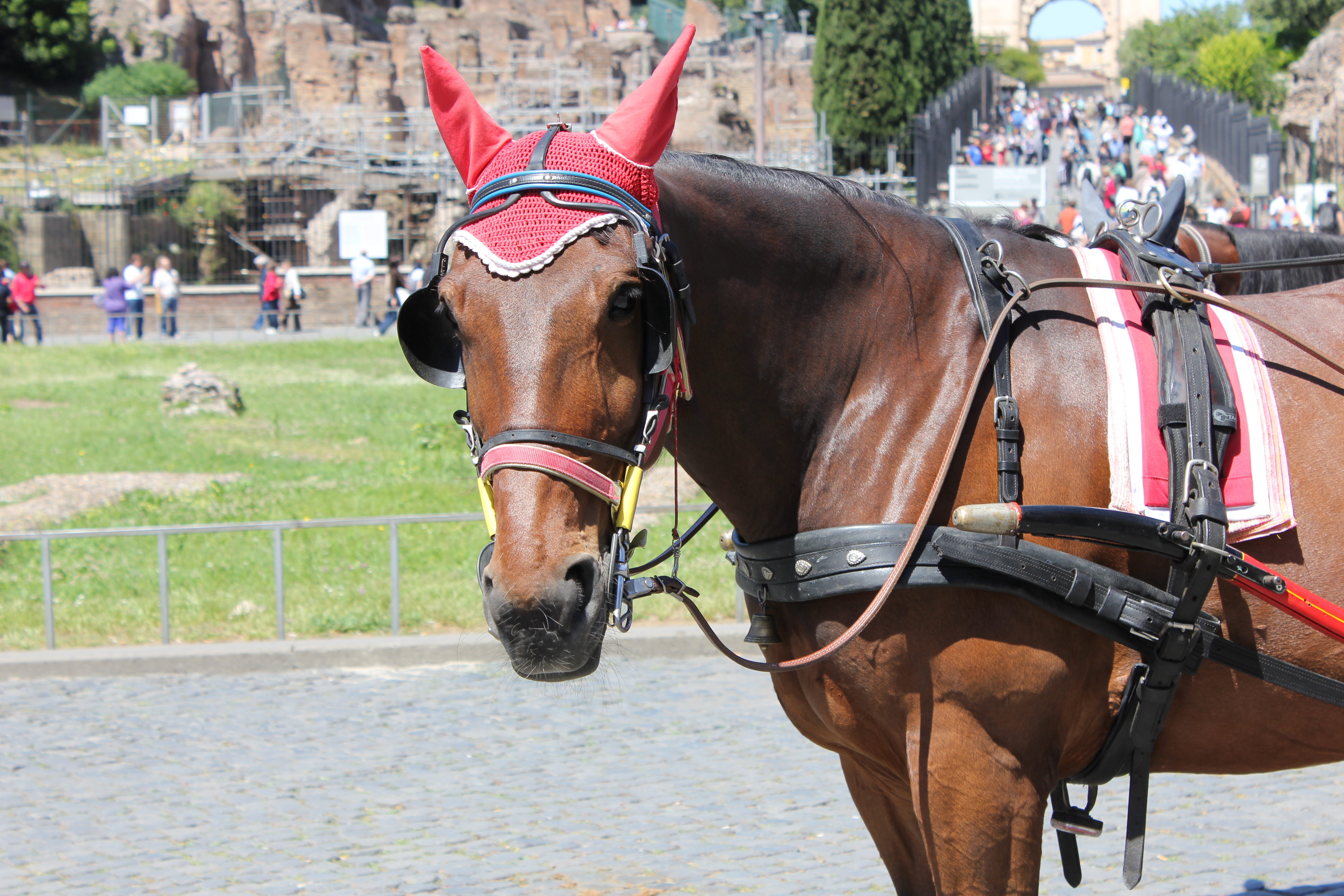
The constant walking with two bags with bricks in them was taking a toll on my back and hips. I sat down in front of the Colosseum and indulged in my favorite activity – people watching, while my weary body rested to build up enough energy to walk back. And I found this gentleman/lady looking at me.

And some Roman soldiers milling around, trying to earn some euros.

Luring tourists into taking pictures with them.

In my contemplative, people watching mood, I also realized a couple of eccentricities of the city of Rome. First is the psychological warfare that goes on daily between the pedestrians and the vehicles. Often, in many streets, there are crosswalks and no lights. The norm is for the vehicles to come to a complete stop to let the pedestrian cross. But I noticed the complete disregard for this rule, especially by the cab drivers. In fact, the vehicles somewhat accelerated threateningly as they came close to the crosswalks, the poor tourists, as a result, quickly stepped up back onto the curb, lacking the courage to boldly step off the sidewalk to face the audacious driver. I hail from Kolkata, where the traffic is synonymous to chaos, I should have been used to this, yet I just couldn’t jump in front of an aggressive cabbie expecting him to brake and let me cross the street. Sean’s suggestion was, not to look them in the eye, just get in front of the car and they will stop. I didn’t think a loving spouse should ask his better half to walk in front of a moving vehicle, but he was trying to be helpful, so I held my peace. On these particular occasions, I loved tour groups. They gave me the confidence to cross the street fearlessly, by being one among many. If there were no tour groups in sight, I sidled against a local who boldly stepped off the curb without giving the on-coming vehicles a second glance, and scurried across with him/her.

The other eccentricity probably applies to all the tourists across the globe. It is their propensity to stop suddenly to either take a picture or exclaim excitedly at a point of interest. I walk fast, I had to stop abruptly on several occasions to avoid a sure collision with my fellow explorer. The beauty of it was, they were completely unaware that they were about to be bumped by me. Most of the times, I smiled indulgently and passed by. Once in a while, when I was tired, hungry and hurting, I did a say a quiet ‘What the heck?’ as I walked by them.

It was almost 2 in the afternoon when I grabbed a lunch of an eggplant, buffalo cheese, sundried tomato and fresh basil pizza and came back to the hotel to rest for a while. I planned to go meet Sean in Trastevere and walk back to the hotel with him.

Piazza Santa Maria, where I waited for Sean. The church of Santa Maria is seen at the back.
A gorgeous mosaic of Jesus and Mary in Chiesa di Santa Maria.

Sean and I strolled along the famous Via Del Corso looking at the designer stores and ended up at the Spanish steps again. I had gone there without my husband, but the romance in the air made me want to go back with him. After all what is the point of being in Rome if one is not kissed on the Spanish steps by the beloved? We witnessed a man proposing to his lady-love and she accepting the proposal on the steps. We all clapped when the gentleman turned to the crowd and said, with tears in his eyes, ‘She said YES!’ We were thrilled to be part of a special and endearing moment. We walked around the steps and went to the Trevi fountains, had a nice dinner of spagghetti carbonara (me) and gnocchi sorrentino (Sean) at a trattoria and a ‘not so yummy’ gelato near Piazza Novona. Then we worked off the dessert by walking through narrow cobble stoned alleyways, which I absolutely loved, to Campo di Fiori – a piazza alive with musicians, diners, tourists and shops.

Campo di Fiori – alive with action.
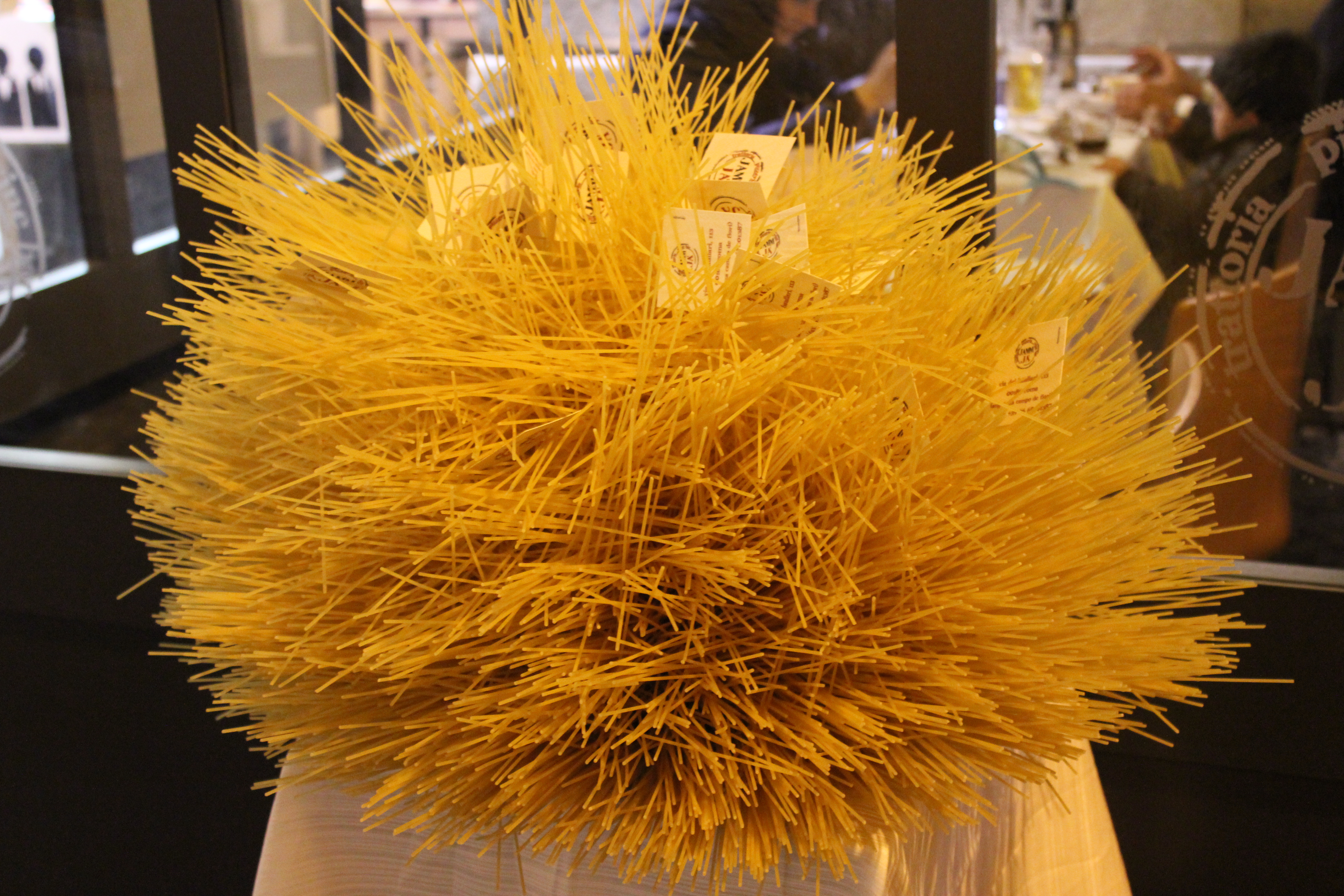
Pasta decoration in front of a restaurant.

Day four ended. I realized I still had the remnants of my country mouse syndrome as Sean had to pull me back on the sidewalk a couple of times as I exuberantly exclaimed at a frescoe or an ancient looking apartment, or flowers on the window sill of a dilapidated house, completely unaware that the person behind me was so close to colliding into ME!!!

Destination for Day 5 – the doma and cupola of the Basilica of St. Peters and maybe Castel Sant’ Angel, if I still had the energy.