

After about a month of sneaking around with my boyfriend, I finally disclosed to my parents that I was seeing someone. The ‘someone’ happens to be from America, his skin color is white and the only Bengali he knows is “Ami tomake bhalobashi” (I love you) that was taught to him by some mischievous coworkers to get him into trouble. The first reaction was of utter surprise. The rule following me was breaking all kinds of rules of romance. I was never told not to fall in love, so “seeing” someone was not the problem. In fact I was told it is best to choose my own partner if I could. Well, I took their advice to heart and then some. I chose someone from outside my state, my country, my religion, my culture. Anyway, I digress.
After the initial shock, I was asked to invite this man to our house. I have already written a blog on that so I will not elaborate. Today I want to write about dal (red lentils). Sean soon became a regular at our dinner table. I remember he was given a knife and a fork with rice, dal, alur dom and some other vegetable. He moved those aside and used his hand to eat like the rest of us. That earned him a lot of brownie points. “Look, he is just like us!” my family often exclaimed.
They spoiled him though. After several experiments, it was established that he loves a very thick dal, tempered with a spicy masala. That kind of dal or masala masoor is more of a North Indian dish. We, Bengalis, like our masoor dal very thin, tempered with dried red chili, kalo jeere (nigella seeds), turmeric powder and slit green chilis. Sean ate at our house at least 4 nights a week and masala masoor was made for him ALL THE TIME!!! When I complained I was told he is the guest and one should make food that the guest likes. All I did was grumble.
Fast forward to our first year of marriage. After eating boring food cooked by Sean for about six months, I took matters into my own hands. I learnt to cook Indian food. Sean praised my initial attempts at making dal and sabji to high heavens so I would take up the mantle of cooking for the family. Since I am a foodie and I realized I enjoyed the task of cooking, I did become the primary cook. Sean is a vegetarian and I am concerned about his protein intake, I make a pot of dal for the family often. It is always thick masala masoor. Unfortunately, my 2 kids love the true Bengali dal which they eat when they go back to Kolkata and they LOVE that. They always complain I make the dal of their dad’s choice and not what the others in the family like. They are not wrong. If you look at the 2 recipes below, you will see that the masala masoor does seem more flavorful, and folks may turn up their nose at the Bengali patla ‘mushur’ dal but trust me, patla ‘mushur’ dal, jhirijhiri alubhaja (finely cut potato sticks), gondhoraj lebu (lime juice) and perhaps a piece of fried hilsa fish or at least a boiled egg is one of the most delicious food to a Bengali. Soul food!
Masala Masoor Dal.
Boil 1 cup of masoor dal (red lentils with about 3 cups of water. Add water if needed to reach desired consistency. It generally takes about 20 to 25 minutes.
In a different pan, heat oil, add a cup of chopped onions and fry them till golden brown.
Add 1 tbsp of ginger garlic paste to the fried onion. Cook till the raw smell is gone, about 20 seconds.
Add one and a half cup of chopped tomatoes. Cook the tomatoes in medium heat till oil separates.
Add a tsp of turmeric, one and a half tsp of coriander cumin powder, half a tsp of red chili powder and 1 tsp of garam masala to the tomato mixture.
Mix well and stir the mixture for about 5 or 6 minutes.
Add the mixture to boiled dal.
Add salt to taste.
Garnish with chopped cilantro, if so desired.
Serve with roti or rice (or eat this as a soup).

Patla Mushur dal
Boil 1 cup of masoor dal in about 4 or 5 cups of water. There should be adequate water even when the lentils are boiled.
In a separate pan, heat a tbsp of oil.
When the oil is nice and hot, add a tsp of nigella seeds (kalonji or kaalo jeere).
Once they splutter, which they will start immediately in hot oil, add 2 dried chili.
Stir once and add the oil infused with nigella seeds and chili into boiled dal.
Add turmeric, slit green chilis (optional) and salt to taste.
Simmer for 10 minutes and your patla (thin) mushur dal is ready.
This is how we eat patla dal. We take a mound of rice on our plate. Then we make a hole in the middle of the rice and serve the dal in that hole. Then we mix the rice and dal, squeeze some lemon juice on to it and eat it with thinly sliced potato sticks.
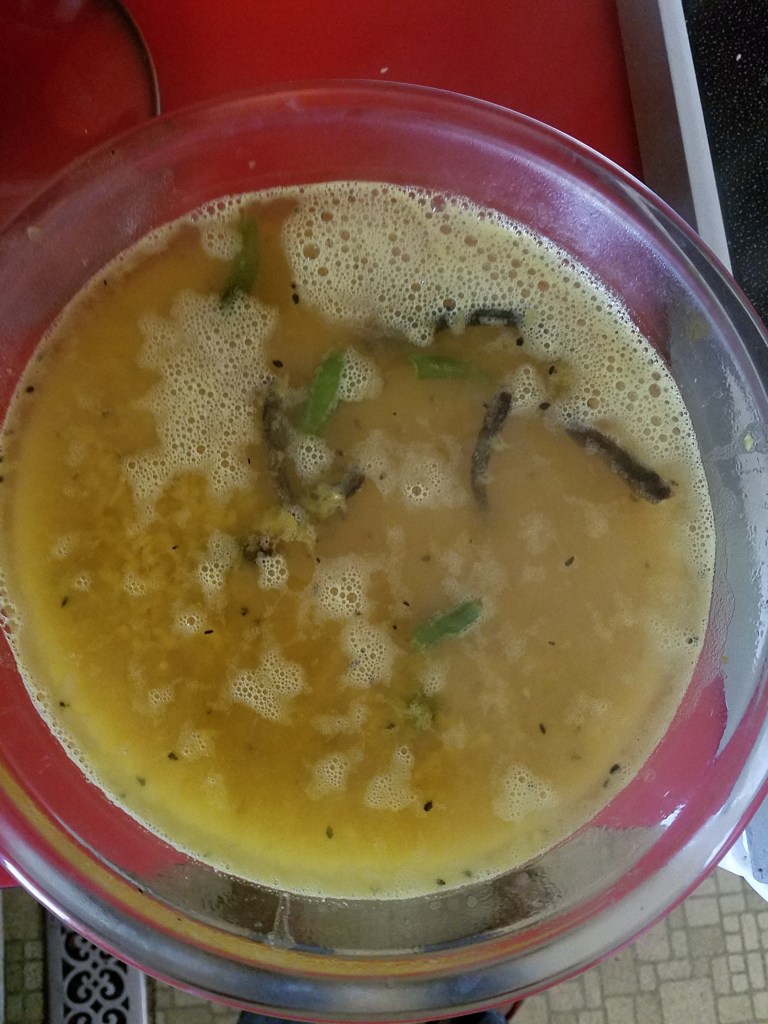
Just writing this down transports me back home. Make both types and then tell me if you are Team thick daal or Team thin daal.
 whatmamathinks