Difficultly beautiful


Author Brit Bennett gifted me a phrase that I have been looking for all my life to describe myself and my dark sisters in this world. Growing up in a country where beauty is measured in how little melanin one has in one’s skin, I understood and related to what Jude Winston, a character in Brit Bennett’s breathtakingly beautiful book, The Vanishing Half felt in her school, her blue black, dark skin a contrast to the light skinned African American children. She was called a ‘tar baby’. Nobody wanted to be her friend or sit with her fearing her dark color would contaminate their fair skin. The question, of course, arises why did Black people revere their light skin and why did Black people shun Jude for her dark, glistening color? Because white skin meant (and means) freedom, white skin meant (and means) opportunity, white skin meant (and means) grabbing the lion share of world’s resources. And white skin also meant (and means) beauty.

Of course, colorism in African American community is just one aspect of the story. The Vanishing Half tells the story of 2 sisters Desiree and Stella Vignes, who were born in a small town called Mallard in Louisiana. A town which was so small that one could not find it on a map. The town had a history though. The founder of the town, Alphonse Decuir, a newly freed slave was son of a white man and a black woman. His color was white and he married a light skinned woman to start off a progeny of very light skinned, white passing African American descendants. The Blacks in the town of Mallard could pass for Whites. The Vignes twins, great, great, great, great, great granddaughters of Decuir, were no exceptions. On August 14th, 1954, when they were sixteen years old, Stella and Desiree, finding no future in Mallard decided to run away to New Orleans. No one in Mallard, including their mother Adele heard from them in 10 years. After 10 years, one morning the townspeople saw one twin, Deisiree walking towards her mother’s house holding a little girl’s hand. Desiree returned back to her mama with her baby girl Jude, but Stella was gone. Stella, the quiet one of the two, left Desiree in New Orleans itself and word had it she lived as a white woman. Why? Stella hoodwinked the world and existed in it as a white woman to free herself from the shackles that bind black people. An incident in their childhood involving their dad imprinted in Stella’s mind that white people had the ability to hurt non whites and not be held accountable for it. Stella wanted to protect herself from that possibility. However, as we read about her life the question arises at what cost did she choose to lead a life of lie? Desiree had not set her eyes upon her twin those last 10 years. It seemed like Stella had disappeared into thin air. Jude, however, does not look anything like her mother, Desiree. She is dark like midnight. And no matter what her white passing grandmother applies on her skin, her color never fades. For inhabitants of Mallard, this blue black child is like a fly in milk, a ‘tar baby’, ‘ugly.’ And later in the story, she is perceived as beautiful, “difficultly beautiful” for some perhaps.

The story is told from perspectives of Desiree, Stella, Jude and Stella’s daughter, Kennedy to give a fuller understanding of the characters and the story. The progression of the plot is non linear, jumping from 1954 to 1968 and then backtracking a few years, only to jump ahead. But this technique was so seamlessly done that it adds to the fluidity of the plot. The book touches on many issues like race relations, transgender, relationships between sibling and children, domestic violence and love. And they all are folded in beautifully within the story of the sisters, the lives of their daughters and other supporting characters that build the foundation of the plot.

This book is brilliant. And I am grateful to Brit Bennett for she the gift of the phrase that will stay with me forever. Difficultly beautiful. Those of us with dark skin grew up hearing:

“You are ugly because you are dark.”

“Black is ugly”.

“Too bad her skin is so dark, she could have been pretty otherwise.”

“Nobody will marry her because she is so dark.”

And it went on and on and on.

We are beautiful, though. We are difficultly beautiful. Difficultly only to those who have been conditioned by society to define beauty in the way that society, media, race dictates. We can only hope they can break out of the shackle. It must be so binding!

Growing my blog


I published a new blog today and after 5 hours of publishing it, my viewership is 17. I have had 10 visitors and my blog site has been viewed 17 times. Before the day ends, if I get 30 views, I will call it a successful blog post day. I guess the whole point of putting one’s thoughts online for public consumption is to have public actually consume it. Well, public in general is not consuming my blog at all. There are, I believe, many reasons for it.

Folks do not like what I write or how I write.

Folks are not interested in what I say or have to say.

There are many engaging reading materials out there.

I am not reaching out or engaging in the blogging community to bring in more viewers.

I seem to be getting followers but they are simply not reading my blogs.

There are myriad of other reasons but my brain is too tired to think of those.

Since there were 0 views on the blog for the last 3 days before I published one blog today, I started wondering what I should do to promote viewership. Should I write more, read more blogs of other bloggers, join blogging groups, comment and like blogs, all of the above?

Then I thought about why I write. I started writing blogs when I was going through a difficult time about 9 years ago. I do not want to share specifics. The blogs were happy and cheery tales of my children. While life was full of terrible anxiety, the blogs were full of sweetness and happy thoughts. They allowed me to cope with reality. This site was my happy place. After the crisis passed, children grew and life became busier, the blog site was mainly forgotten till the pandemic hit. Again, the blogs came to my rescue. I started putting down my thoughts, memories and stories on this platform, ones I thought were worth sharing. Although very few people read it, I have one dedicated reader who reads it without fail, rates them with 5 stars and posts a love on my Facebook share, and tells me often that my blogs make her happy. Her love matters most as these blogs contain a large part of her tween and teenage, her mother’s thoughts and stories of her life. These blogs will hopefully serve as her treasure chest of memories once I am gone.

So do I want viewership to my blogs grow? Absolutely! Will I make an effort to be part of a blogging community? No. The reasons being I am lazy, I like to read books, write my thoughts once in a while and watch Call of the Midwives obsessively (lately).

At the end of the day, I write because it makes me happy. Some of you read the blogs and leave a comment or like. That makes me happy too Thank heavens I kept my day job! 😀

The rice seller auntie (chaalwali mashi)


One side effect of growing old is getting lost in memories. Certain smells, words, actions evoke memories of yester years and I get lost in them. As the sweet smell of cooked rice wafted towards me this morning while I chopped vegetables, I remembered this middle aged woman who came to our house every 20 days or so to sell rice when I was growing up. I was quite young when she first started coming. I recall she came into our bedroom and sat in the corner on the cool mozaic floor, wiping the sweat off her face with the pallu of her sari. Whoever was around brought her some water, unasked. She talked to ma while she drank her water and let the cool breeze from the fan dry her sweat soaked body. She talked to ma about her family, her husband who could not work due to some injury, her sons who were going to school. Then she spread out our preferred quality of rice on the floor and measured cupfuls into a big container that we gave her. I forget the exact kilograms of rice that we bought from her each month but it was a significant amount since rice is staple in a middle class Bengali family, especially at a time when white rice was not touted as evil and full of empty calories. We loved our rice and we loved our chaalwali mashi, Angoor. That was her name – Angoor, which means grapes in English. 🙂

I listened to her stories under the guise of finishing homework as she sat with her glass of water, cooling herself in front of our big standing fan on an extremely hot summer afternoon before she carried her bag of rice to her next customer. I remember hearing about her sons growing up over the years, getting married and then, best of all, telling their mother to not work anymore. They were able, they told her. They can take care of her from then on. The day she told us about her sons, the young men she raised, imploring her to take rest, the smile on her face shone like a diamond. All her efforts in raising her sons had found fruition.

For many years she woke up before dawn, went to wholesaler to pick up bags of rice, took a local train to come to Kolkata from her remote village with other women from her area to sell rice in Gariahat market. Every evening she got on the local train to go back home after a grueling day in the city, cooked for her family and took care of her boys. She said her husband stayed home and helped as much as he could. She was one of the lucky ones.

The smell of rice this morning brought memories of chalwaali mashi to the forefront. Ma always bought her a new sari for Durga pujo. And every year, she touched the sari with a lovely smile, looked up to my mother and said, “Khub sundar hoyeche boudi.” (It is very pretty, sister-in-law.)

I have not thought about her for many years. I don’t even know if she is alive. I asked ma about her recently. She does not know any news about Angoor mashi either. She only said, “Manush ta boro bhalo chilo.” (The woman was so very nice.)

Men and women come in our lives, sometimes for a substantial period of time. And then they disappear too. They simply leave behind some vignettes of memories. As we get older, we look back at those and bring them back into existence. We think about them. We wish them well, wherever they are.

“A tree fell on my childhood…literally!”


There is a beautiful, majestic tree in my backyard. I love the tree so much that I have even written a sentimental blog about it.

You can read the blog here.

As a very irresponsible parent, I allowed my 10 year old daughter and 5 year old son to build a ‘tree house’ along with 5 other similarly aged neighborhood children on the branches of that tree. Why is that irresponsible you ask? Because there was no adult supervision there. None! I shudder to think all the accidents that could have happened in the process. But it didn’t and they are alive to tell the story. So there’s that.

The tree house was simply some planks that were lying around in my neighbor’s yard. The children dragged those planks to our back yard, gathered huge nails and hammers. They hammered those heavy planks on to the branches of the tree and created a platform kind of a structure. As I write about it, I envision broken thumbs, pierced skin, flattened skulls – but none of those happened. As they hammered way above the ground, I calmly washed dishes, cooked dinner not worried about their safety at all. My neighbor finished her chores in her house unafraid as well. What were we thinking? Looking back, I think it was summer, the children were little and we wanted them out of the house. And it makes me embarrassed to think I was so calm while they were embarking upon such dangerous activities.

The ‘tree house’ was finished. The unabashed pride on those little faces at their accomplishment was priceless. They announced to the world that they had built their tree house all by themselves without any help from grown ups. Many afternoons were spent up on that tree house. Many picnics were had, many games were played, many imaginary friends were invited. Sahana was obsessed with spy games where she was the main spy with an assistant. The little brother, at that age, was honored to be an assistant and took his role very seriously. I have this precious photo of them as they played on their tree house.

No description available.

And yes, pictured above is their tree house. To them it was the best tree house that ever existed in the universe and who are we to dispute that?

As they got older, like many things in their childhood, the tree house was slowly forgotten. Sean looked up at the decaying planks and often talked about taking them down but never got to it. Recently, after a major storm, one of the limbs of our beautiful tree cracked and after hanging on an unused wire for a while it finally hit the ground one afternoon along with some rotted planks of the tree house (or tree platform). Sahana and I were having tea on the back deck when it happened.

“Mom, our tree house is falling down.” She exclaimed. “Did you see that? A tree fell on my childhood……literally!”

Since I am the archivist of her childhood, I will put this memory too in the treasure box. She can open it and peruse at her leisure. No tree shall fall on her childhood under my watch! 🙂

Morocco, argan oil and bad memories.


A big debate ensued within the family. Should we visit Sahana in Madrid over Christmas break in 2019 and tour Spain as a family or go someplace else so Sahana, along with us, can see a new country? My vote was for Spain, Sean wanted to go to a new country since Sahana would be touring Spain anyway as she was spending her junior year of college there. I held my ground till Sean floated the idea of Morocco. Why would I NOT want to go to Morocco? Spain could wait.

Sean, Ryan and I left for Morocco a few days before Christmas and flew into Casablanca. We had already rented a car and a very nice man was waiting for us with our vehicle at the airport. Sahana flew in from Madrid and met us at Casablanca airport as well. Finally reunited with our darling daughter after 4 months, we drove 210 miles from Casablanca to Chafchouen, a gorgeous, blue city at the foothills of Rif Mountains in North West Morocco. We parked our car in the dark and went in search of the riad that we had booked for a few nights. A riad is a traditional Moroccan home that are very popular with tourists to get the full experience of staying in Morocco. We lost our bearing completely while navigating the serpentine, narrow and sometimes steep alleys of the ‘blue city’ and after asking several locals, we finally arrived at Riad Nersjaonsar. The owner was sitting on a bench just outside and welcomed us with a big smile. We went into our room, cleaned up in the common bathroom, went to sleep and woke up at 11:00 am the next morning. Although breakfast was only served till 10 am, the very hospitable owner had his son cook Moroccan bread, eggs and Moroccan coffee for us along with fresh orange juice, rich honey. We ate breakfast on the terrace under the shadow of the Rif Mountains. It was magical. Our tour of Chafchouen will always be the brightest spot of our Moroccan trip and I will let some photos do the story telling.

Navigating the alleyways of the blue city, Chafchouen
The walls of the ‘blue city’ were painted in this hue to keep mosquitoes away.
One of the many beautiful gateways.
Artist selling his painted mosaic tile in Medina in Chefchouen

Our next destination was Fez. However we stoped in Volubilis on our way to Fez to explore the ruins of the Roman city. After spending a beautiful day walking among the Roman ruins and marveling at the ingenuity of Roman engineers and builders, we got in our car to drive on to Fez. Again, we wanted the experience of staying in a riad in the old part of Fez. We arrived at beautifully decorated Riad Sunrise.

View of the inner courtyard from our room in Riad Sunrise
Typical Moroccan breakfast.
In Fez Medina

The medina (market) of Fez was magical and it seemed like we had stepped into history however my memory of the city is tainted by the youth who offered to take us out of the labyrinth of the Medina and then asked for an exorbitant amount of money. We did not pay but I was concerned that he might hurt us.

Fast forward to Marrakesh, a gorgeous city of wide avenues, beautiful gardens, historic Medina, famous Koutobia mosque and fashionable people. We all were looking forward to desert visits and camel rides. The plan was to spend the night of December 31st in the middle of Sahara desert. Sean and I did not book anything in advance and we thanked our lucky stars for that later. We were staying in Marrakesh for 6 days, so we thought we had ample time to book a desert tour. After an early pizza dinner on the day we arrived, we retired to bed, hoping to explore the city and book our desert trip with a local tour company the next day. I woke up in the middle of the night to the sound of Sahana retching in the bathroom. That was the beginning of our nightmare. She had one of the worst cases of stomach infection that went on for days. While she rested in the hotel room, glassy eyed and dehydrated, Sean, Ryan and I went out for short walks to buy some dinner and to bring back crackers and electrolytes for Sahana. Each day we thought maybe Sahana will recover and we can still book a desert trip. On the third night, I was gently awoken by Ryan saying, “Mom, I just threw up. But don’t worry, I feel fine now.” Well, he did not feel fine for long. From that point on both of them threw up every hour as Sean and I tried to keep them hydrated. When they were not throwing up, they were taking hot showers or resting in their beds. Sean and I went for long walks to get fresh air when the kids rested and toured Marrakesh as much as we could. I fell in love with the city, despite the nightmare that was unfolding in our hotel suite. Here I must mention the kindness of our housekeeper, Nadia, who without saying a word of English, commiserated with the kids, with us, cleaned up their mess and asked me if the children had eaten at the Medina. They had not. She always made sure to bring us extra towels and sheets. I was touched by her kindness in that foreign land and when we checked out, we made sure we left a generous tip for her.

I picked up a small vial of argan oil from a supermarket (of all places) in Marrakesh. I had no idea what argan oil was or what purpose it served before going to Morocco. I simply wanted a memento of the country that I could bring back in my carry on luggage and I saw argan oil being sold EVERYWHERE in every Medina we visited. Argan oil came home with me along with regrets, some anxious moments, bad memories and some amazing experiences.

I started using argan oil on my face as a moisturizer and also on my wild hair. The change in my skin and hair within a couple of weeks was remarkable. This oil not only moisturizes but also protects from sun damage, reduces wrinkles, prevents skin from getting too oily. I am a convert. And for my hair? Well it controlled my uncontrollable frizz! Enough said. After my small vial from Morocco was gone, I bought more of the oil, and now that is a part (only part) of my beauty regime. As I was massaging argan oil in my hair last night, the memories of Morocco came flooding back to me. I could not bring myself to write about that trip right after our return because it seemed like a vacation of nightmares. However, enough time has passed and the bad memories are slowly being replaced by memories of magical Chafchouen and the wonderful welcome we received there from the locals, memories of walking miles and miles in beautiful Marrakesh with Sean taking in the glitz of the big city juxtaposed with the narrow alleys of colorful Medina steeped in history.

Sahara eluded us this time and most likely we will not go back to Morocco for a vacation. I am still not sure what my children ate to cause such violent sickness and why us, the parents, were spared but if I could I would go back in a heartbeat, because, I for one, absolutely loved what I saw in this beautiful country. And the country gave my my magic potion along with some stress related highlights (gray hair) – argan oil!

Double As and one A+


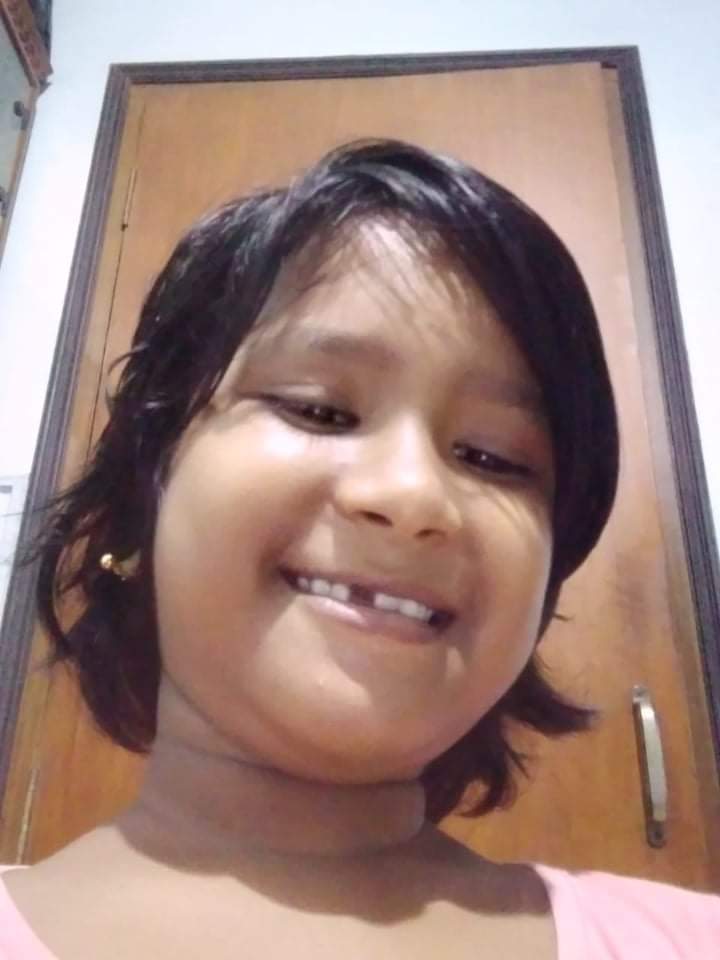
There was a celebratory air in my home in Kolkata today. As I chatted with ma and baba this morning, right after “tora kemon achish?” (how are you all), I was informed Khushi’s report card is out and she has done very well in school. I saw baba’s face on the camera grinning from ear to ear, while I heard ma’s proud voice in the background, “She got double A in all subjects, A+ in just one.” By baba’s side, with a lovely gap toothed smile stood 7 year old Khushi, looking at me through the computer. My usual Thursday morning suddenly became festive.

She is a 7 year old little girl. Her successful report card for one semester may not seem worth celebrating to some. However, when one knows the relentlessness of her mother to ensure that Khushi receives quality education despite all the obstacles that is thrown in their path, one can not help but doff one’s hat in respect. Khushi’s mother, Breshpati, barely knows Bengali alphabets. She can not read. Once she had Khushi seven years ago, she made a resolution that her child will have every opportunity to education and resources that she lacked. She was employed as a maid early on in childhood so her two brothers could attend school. Her daughter, she vowed, would have a different life. Hearing the hope in her voice as she held her new born in her arms, I enlisted myself as a soldier beside her to help achieve her dreams for her daughter. The real work was done by her mother. Breshpati worked in people’s houses as a domestic help for livelihood yet ensured that her day afforded enough time for her to take Khushi to her tutor’s house for lessons or to her dance class or to her drawing class. Khushi’s birth in a financially strapped family was not going to take away opportunities from her – that was her mother’s promise.

Schooling during Covid has been especially challenging. Schools went online. It took Breshpati and my parents quite an effort to understand the technology. Little Khushi figured out how to attend classes before her grown ups did though. She attended school from our living room, neatly attired in her school uniform and did her homework with the help of her tutor, a lovely young woman who also comes from an impoverished family, and with the help of my mother.

Attending school

Every morning she sits next to baba as he reads the Bengali newspaper and tries to sound out the difficult words along with him. He helps her with the words if she stumbles. Ma makes sure her penmanship is good and her grammar is perfect. When we video chat with them, they proudly summon her to greet us in English. She asks us, “How are you?” And my parents marvel at her lovely English pronunciation. She recites for us sometimes and dances too. She loves performing and is a natural in front of canera. The adopted grandparents look on with unabashed pride.

When I heard about her good result, I asked my parents to buy her a gift to celebrate her success. Her mother chimed in, “No didi, don’t give her anything. Let us see how she does in her final exams.” We compromised on a chocolate bar while promising a bigger celebration after her final report card, which I believe will be equally good.

I am not sure what is in store for this little girl. Education is not the top priority in the neighborhood she lives in. Girls marry young and become young mothers. Her mother, however, talks of endless possibilities for her daughter. She tells her child she can become anything in life, just get an education. She lays out the only path available to Khushi that will be her ticket out of poverty. My parents and my family here are cheerleaders and supporters.

That little girl is surrounded by love and support. That may just be enough to see her through. She and her mother fill me up with hope.

Going home…


I was talking to the lovely receptionist at my doctor’s office this morning, sharing frustrations of having loved ones far away. She is from Trinidad. Like many of us, she can not go home to see her parents. Borders are closed. We commiserated over our situations and the situations of millions around the world. Stuck. Since then I have checked Emirates website at least 3 times. The intensity of my desire to go home multiplies everyday.

Compounded with all the other worries associated with this pandemic, the feeling of being stuck and not being able to reach my ma and baba plunges me in depths of despair, robbing sleep at night. This, unfortunately, is not exclusively an immigrant problem. I was sharing my concerns with a friend at work. She lives a few streets away from her parents however she said she has not seen them as she is afraid to see her elderly parents for the fear of bringing infection to them. Another friend lost her dad during the height of pandemic and was afraid to give her mother a hug or hug other family members and friends who came to celebrate her father’s life. My husband has not been able to see his mom living in an assisted living facility in a different state. The gates to their loved ones are also closed. Although us, immigrants, have longer distances to travel to reach our family, we all share the same agony of not being able to reach/see those close to our heart.

Sometimes I fantasize my reunion with my parents. First of all, how would I feel when the plane’s wheels touch City of Joy after this horrible disease has a vaccine? How my first sighting of those beloved faces will feel like? We are not a hugging family. When we first see each other we give a perfunctory hug but we all feel that is not natural. We smile though. We smile so wide that it feels like our mouths can not stretch any more. And ma invariably puts her hand on my arm, perhaps to feel that yes, I am really there in front of her in flesh. She strokes my arm gently and in that touch I feel all her love pouring into my being. My father has a beaming smile as if his whole soul is lit up. Finally! Their child has arrived. Then we follow baba outside the relative calm interior of Dumdum airport into complete chaos, smell of dust and blast of humidity of Kolkata. We wait with our luggage talking to ma while baba texts the driver of the rented car to come pick us up. On the long drive home, we are presented with bottles of water and almost always a Cadbury Fruit and Nut chocolate bar. My favorite. I don’t eat it then, but just getting it from ma and baba fills me up with the feeling of being small again. It is hard to explain.

I am sending positive vibes to the universe. End this pandemic. End this for so many reasons but also for me, in this little corner of my world. I want to go back home. I want to go to bed in my Kolkata home, wake up completely jetlagged in the middle of the night and then sit by the window in the living room, facing east to see the morning sun rise over the coconut trees behind our 5th floor apartment.

I want to hear the first caws of crows as they convene for their morning meetings, the first whistle of local train bringing workers to the city from villages, the sound of running water as the slum across from us wakes up to a new day, the soft tinkling of glass bangles as the neighborhood women come to the municipality tap to wash dishes, wash themselves, collect water. I want to sit next to my mom and dad, drinking a cup of tea with Parle G biscuit and looking out the french window where the world is obscured by my father’s plants.

I want to feel their presence. I want be in their presence. I want to be asked that question so filled with love, which no one else ever asks me, “Aaj ki khabi?” (What do you want to eat today?)

As I write these memories down, I see the scenes in my mind’s eye. I almost smell the smells of home, almost feel the love, almost touch the other slice of my life. The slice that I leave behind when I cross the ocean each time. Almost, but not quite…

Universe, hear my prayer.

Whatcha got?


Once upon a time a little boy needed help with homework. He ran to his mom and dad asking questions about math or English or social science. Mom or dad helped him figure out his math problem or his English grammar or told him what they remembered about that particular social science question. Invariably and without fail, the little boy turned to his almost six years older sister and asked, “Sahana, is that correct?”

We laughed. Why do you ask us if you need your sister to validate our answers? I believe he asked us out of habit but his full confidence was in his sister. If sister confirmed that the parents were correct, he would accept our answers.

As the boy and girl grew older, there were conflicts. Both of them grew up with their own views on life, society, media and politics. Both of them are independent thinkers (read stubborn). While they agree on basic values like equal rights, social justice, kindness, empathy, honesty, their means to get there sometimes differ. There are arguments, often heated.

I had the opportunity to watch their interactions during this pandemic in close quarters. While bickering still happens and it still drives me insane, I do get a preview of how they will relate to each other as adults. The girl turned 21 and the boy turned 15. They continue to debate policies and political beliefs with the zeal of their convictions. Debates can be still heated and tempers still flare, yet I often hear, “Ok, I see your point. But….”. Lately, I have witnessed more of sharing and laughing though. Often the laughter is directed at their aging parents, but mostly in a good natured and fun way.

I hear, “Ry, I am making pasta for myself, do you want some?”

Or “Sahana, I made popcorn. I left half a bag for you.”

I hear, “Sahana, I can’t find my phone.” And then, the phone is invariably found by sister accompanied by elaborate eye roll and an indulgent, “You dummy!”

It warms my heart to see they often speak the same language – pop culture language.

I hear, “Hey Ryan, did you watch (insert tik tok star name)?” or “Sahana, you gotta see this.”

A few days ago, I overheard a loud broken teen boy voice shouting from his room to his sister.

“Hey Sahana, I have English homework. You gotta help me.”

“I gotta, huh?” She laughs.

Then he saunters over to her room, slouches on her bed:

“Awright, I have to draw a picture between Victorian society and Oscar Wilde’s The Importance of Being Earnest. Whatcha got?

Sahana, despite being in the middle of her homework, smiles and turns around to help.

They are figuring it out. After years of refereeing conflicts between these two, this mama watches from the side line. A warm feeling of love envelopes her as her two favorite humans in the whole wide world come together in their own unique ways.

Read while isolated.


Despite lack of focus at the beginning of pandemic, I did end up reading a lot of books. These are some which I liked, loved and thought about.

https://chapterchats.org/2020/09/16/read-while-isolated/

The thick and thin of dal.


After about a month of sneaking around with my boyfriend, I finally disclosed to my parents that I was seeing someone. The ‘someone’ happens to be from America, his skin color is white and the only Bengali he knows is “Ami tomake bhalobashi” (I love you) that was taught to him by some mischievous coworkers to get him into trouble. The first reaction was of utter surprise. The rule following me was breaking all kinds of rules of romance. I was never told not to fall in love, so “seeing” someone was not the problem. In fact I was told it is best to choose my own partner if I could. Well, I took their advice to heart and then some. I chose someone from outside my state, my country, my religion, my culture. Anyway, I digress.

After the initial shock, I was asked to invite this man to our house. I have already written a blog on that so I will not elaborate. Today I want to write about dal (red lentils). Sean soon became a regular at our dinner table. I remember he was given a knife and a fork with rice, dal, alur dom and some other vegetable. He moved those aside and used his hand to eat like the rest of us. That earned him a lot of brownie points. “Look, he is just like us!” my family often exclaimed.

They spoiled him though. After several experiments, it was established that he loves a very thick dal, tempered with a spicy masala. That kind of dal or masala masoor is more of a North Indian dish. We, Bengalis, like our masoor dal very thin, tempered with dried red chili, kalo jeere (nigella seeds), turmeric powder and slit green chilis. Sean ate at our house at least 4 nights a week and masala masoor was made for him ALL THE TIME!!! When I complained I was told he is the guest and one should make food that the guest likes. All I did was grumble.

Fast forward to our first year of marriage. After eating boring food cooked by Sean for about six months, I took matters into my own hands. I learnt to cook Indian food. Sean praised my initial attempts at making dal and sabji to high heavens so I would take up the mantle of cooking for the family. Since I am a foodie and I realized I enjoyed the task of cooking, I did become the primary cook. Sean is a vegetarian and I am concerned about his protein intake, I make a pot of dal for the family often. It is always thick masala masoor. Unfortunately, my 2 kids love the true Bengali dal which they eat when they go back to Kolkata and they LOVE that. They always complain I make the dal of their dad’s choice and not what the others in the family like. They are not wrong. If you look at the 2 recipes below, you will see that the masala masoor does seem more flavorful, and folks may turn up their nose at the Bengali patla ‘mushur’ dal but trust me, patla ‘mushur’ dal, jhirijhiri alubhaja (finely cut potato sticks), gondhoraj lebu (lime juice) and perhaps a piece of fried hilsa fish or at least a boiled egg is one of the most delicious food to a Bengali. Soul food!

Masala Masoor Dal.

Boil 1 cup of masoor dal (red lentils with about 3 cups of water. Add water if needed to reach desired consistency. It generally takes about 20 to 25 minutes.

In a different pan, heat oil, add a cup of chopped onions and fry them till golden brown.

Add 1 tbsp of ginger garlic paste to the fried onion. Cook till the raw smell is gone, about 20 seconds.

Add one and a half cup of chopped tomatoes. Cook the tomatoes in medium heat till oil separates.

Add a tsp of turmeric, one and a half tsp of coriander cumin powder, half a tsp of red chili powder and 1 tsp of garam masala to the tomato mixture.

Mix well and stir the mixture for about 5 or 6 minutes.

Add the mixture to boiled dal.

Add salt to taste.

Garnish with chopped cilantro, if so desired.

Serve with roti or rice (or eat this as a soup).

Masala masoor

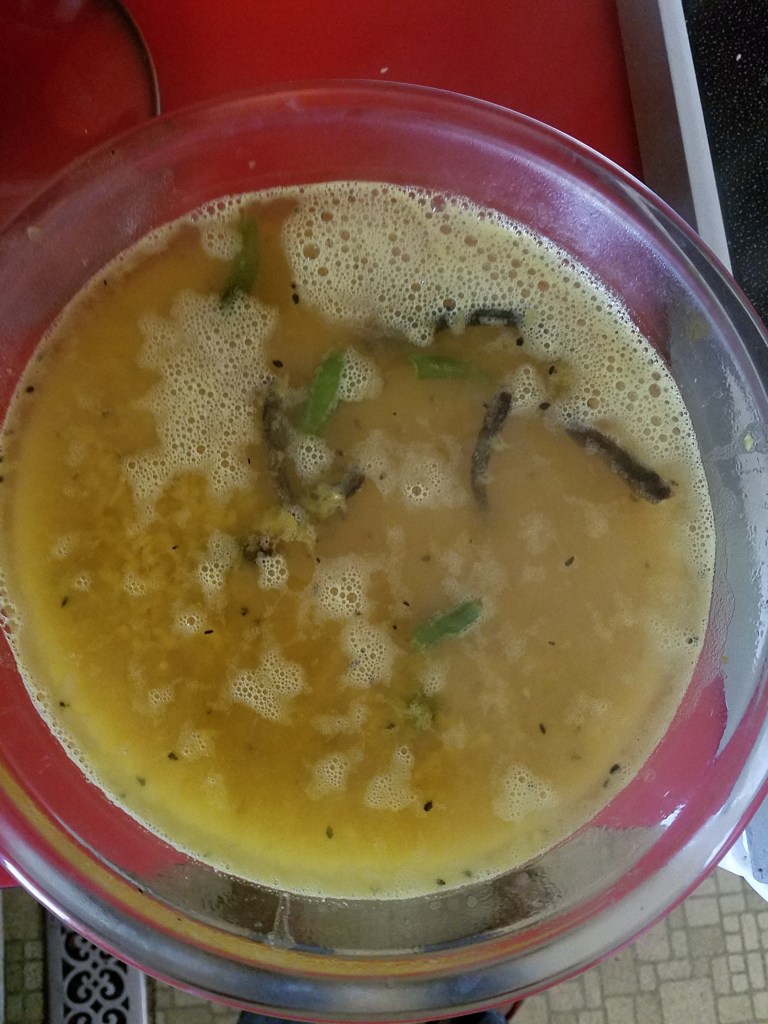
Patla Mushur dal

Boil 1 cup of masoor dal in about 4 or 5 cups of water. There should be adequate water even when the lentils are boiled.

In a separate pan, heat a tbsp of oil.

When the oil is nice and hot, add a tsp of nigella seeds (kalonji or kaalo jeere).

Once they splutter, which they will start immediately in hot oil, add 2 dried chili.

Stir once and add the oil infused with nigella seeds and chili into boiled dal.

Add turmeric, slit green chilis (optional) and salt to taste.

Simmer for 10 minutes and your patla (thin) mushur dal is ready.

This is how we eat patla dal. We take a mound of rice on our plate. Then we make a hole in the middle of the rice and serve the dal in that hole. Then we mix the rice and dal, squeeze some lemon juice on to it and eat it with thinly sliced potato sticks.

Patla mushur dal

Just writing this down transports me back home. Make both types and then tell me if you are Team thick daal or Team thin daal.